Quick Answer: What Is an Arabic Root?
An Arabic root is a set of consonants — most often three — that carries a core area of meaning. Arabic builds many words by combining these root letters with different patterns.
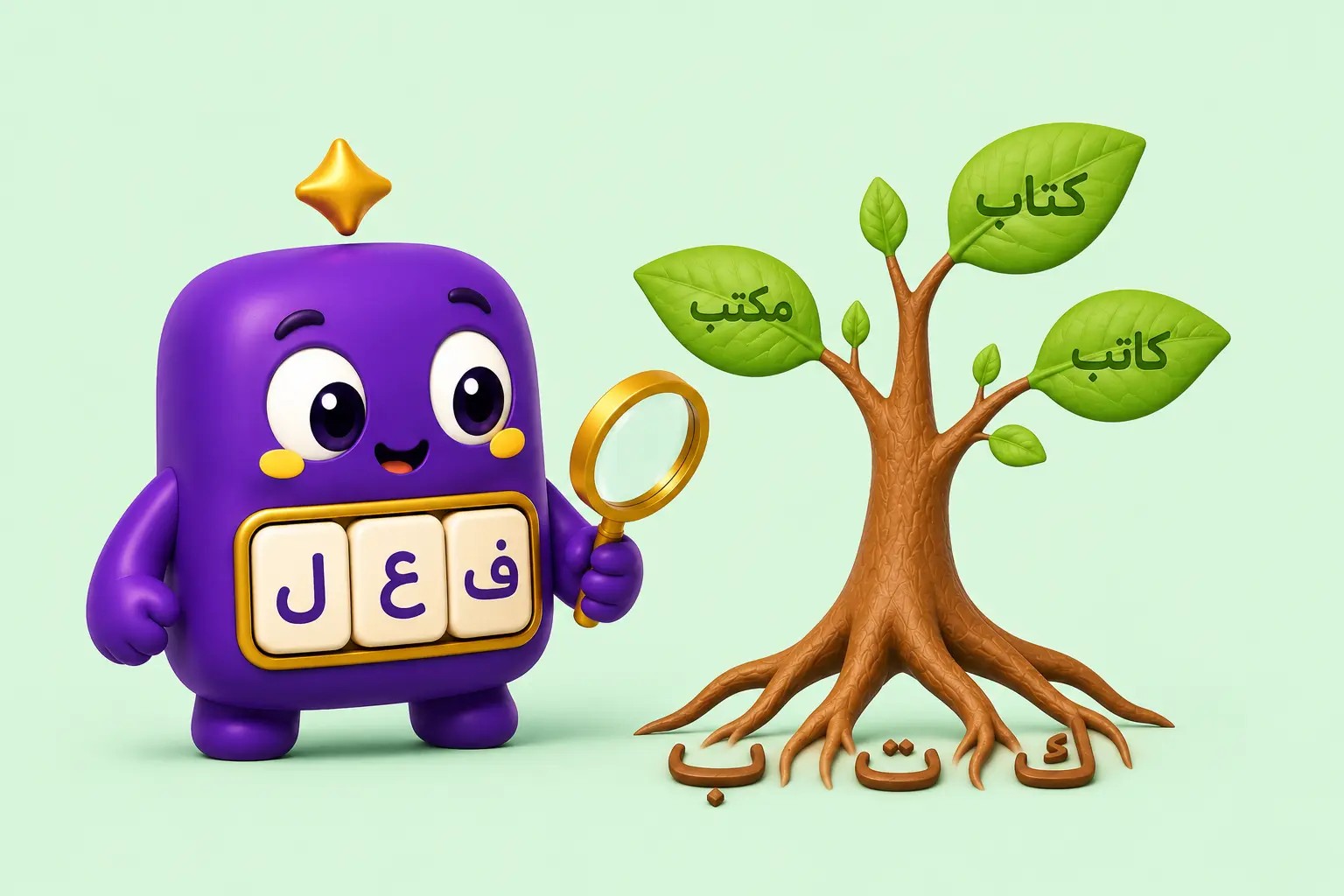
For example, the root ك ت ب (k-t-b, "writing") appears in:
- كِتَاب (kitāb) — book
- كَاتِب (kātib) — writer
- مَكْتَب (maktab) — office or desk
- مَكْتُوب (maktūb) — written
Once you recognize the root, words that once looked unrelated begin to look like members of the same family.
What Exactly Is an Arabic Root?
Imagine seeing كِتَاب (book), كَاتِب (writer), and مَكْتَب (office/desk) for the first time. To a beginner, they may simply look like three vocabulary words that have to be memorized separately.
But look again: كِتَاب, كَاتِب, and مَكْتَب all share the same three consonants — ك ت ب (k-t-b). That recurring consonantal core is the root.
Much of Arabic vocabulary is organized through a system in which a root interacts with a pattern to form actual words. The root carries a semantic core, while the pattern contributes the form and grammatical or lexical function of the resulting word. A simpler way to think about it:
The root gives you a family connection. The pattern helps turn that root into a particular word.
So an Arabic root is not normally a complete word waiting to be pronounced — you wouldn't encounter ك ت ب in a sentence and pronounce it "k-t-b" on its own. Those three letters are an abstract representation of the root; the actual vocabulary consists of words built around it.
Why Are Arabic Roots Important?
When learning English, you often encounter words that provide few obvious clues about one another. Arabic, by contrast, frequently makes relationships between words visible through recurring consonants. Once you know كِتَاب (book), and later meet كَاتِب (writer) and مَكْتَب (office/desk), you notice the same ك ت ب each time — you're no longer meeting every word in isolation, you're beginning to see a network. This kind of systematic derivation from lexical roots plays a central role in creating Arabic word stems and expanding the lexicon. For a side-by-side look at how this differs from English word-building, see the Arabic root-and-pattern system vs. English prefixes and suffixes.
For learners, this matters for three practical reasons:
- Vocabulary becomes connected. Instead of "here are five unrelated words I must memorize," it becomes "here are five members of one word family" — your memory has something meaningful to organize around.
- Unfamiliar words become less mysterious. Recognizing a root doesn't guarantee you can correctly guess a word, but it gives you a useful clue — a general semantic neighborhood before you check the precise meaning.
- Dictionaries become easier to understand. Many traditional Arabic dictionaries organize vocabulary by root rather than by the spelling of the complete word.
How Does a Root Become a Real Word?
A root by itself doesn't tell the whole story — Arabic also uses patterns. Think of the root as a set of consonants and the pattern as a structure into which those consonants fit. Traditional Arabic grammar often represents root positions using the placeholder ف ع ل (f-ʿ-l).
Different arrangements of vowels and additional letters around the same root consonants produce different words: كَاتِب (kātib, writer) and مَكْتُوب (maktūb, written) share the same root consonants, but they aren't the same word. A useful beginner model:
root (a semantic family) + pattern (a word-building structure) → word
This is why learning Arabic roots is powerful — but learning only roots isn't enough. You need both sides of the system.
A Complete Example: The Root ك ت ب
Let's follow one root — ك ت ب (k-t-b, semantic field: writing) — through several real words:
| Arabic | Transliteration | English | Relationship |
|---|---|---|---|
| كَتَبَ | kataba | he wrote | the act of writing |
| يَكْتُبُ | yaktubu | he writes | present-tense writing |
| كِتَاب | kitāb | book | something associated with written material |
| كَاتِب | kātib | writer | a person who writes |
| مَكْتَب | maktab | office / desk | a place associated with writing/work |
| مَكْتُوب | maktūb | written | something that has been written |
| كِتَابَة | kitābah | writing | the act or practice of writing |
Don't memorize the table as seven separate translations — look for the family resemblance instead. Seven words, one connected family.
Does the Root Always Give You the Exact Meaning?
No — and this is an important beginner lesson. A root gives you a semantic connection, not a perfect English definition you can paste onto every derived word. Saying ك ت ب is associated with "writing" is useful, but that doesn't mean مَكْتَب literally means "writing" — it means office or desk. The relationship to the broader word family is meaningful, but the actual word has its own lexical meaning.
This distinction protects you from a common mistake: trying to translate Arabic by roots alone. Take another family, ع ل م (ʿ-l-m, a semantic field involving knowing/knowledge): عِلْم (ʿilm, knowledge/science), عَالِم (ʿālim, scholar), تَعَلَّمَ (taʿallama, to learn), تَعْلِيم (taʿlīm, teaching/education). The relationship is visible, but each word still has to be learned in its own right. A root is best treated as a map of relationships, not a substitute for a dictionary.
Are All Arabic Roots Three Letters?
No — and this is one of the places beginner explanations can become misleading. Arabic roots are most commonly triliteral (three consonants) — think ك ت ب, د ر س, ف ت ح. But Arabic also has roots with other numbers of consonants, including quadriliteral roots. A familiar example is ت ر ج م (t-r-j-m, associated with translation): تَرْجَمَ (tarjama, he translated), تَرْجَمَة (tarjamah, translation), مُتَرْجِم (mutarjim, translator).
So the useful beginner rule: Arabic roots are usually three consonants, but not always.
Can You See the Root Inside Every Arabic Word?
Not always. When roots are first introduced, Arabic can appear almost mechanical: find three letters, identify the root, understand the word. Real Arabic is more interesting than that. The root-and-pattern system is central to Arabic morphology, but the lexicon also contains basic lexical items, borrowed words, and words created through processes like suffixation and compounding that aren't straightforward products of the root system.
Roots can also change their visible appearance in actual words — roots containing و (w) or ي (y) can shift in different morphological environments, traditionally called weak roots. You don't need to master weak roots yet. For now, just remember: roots reveal structure, but Arabic is a living language, not a code where every word can be decoded mechanically.
How Roots Help You Learn Vocabulary
Imagine learning twenty completely unrelated pieces of information, versus twenty pieces organized into four families. Which is easier to remember? That's one reason roots become such a useful vocabulary-learning strategy.
When you learn a new Arabic word, don't stop at "what does this word mean?" Ask three more questions:
- What is its root?
- What other words belong to this root family?
- What changes when the root appears in different patterns?
Take مَدْرَسَة (madrasah, school): its root is د ر س (d-r-s), and the family includes دَرَسَ (darasa, he studied), دَرْس (dars, lesson), دِرَاسَة (dirāsah, study), and مُدَرِّس (mudarris, teacher). One vocabulary item just became an entry point into an entire family.
How Arabic Dictionaries Use Roots
At some point you may open a traditional Arabic dictionary, search for a word exactly as it appears, and wonder why you can't find it — the dictionary may be waiting for the root instead. See مَكْتُوب (maktūb, written)? Recognize ك ت ب, and you can look under that root to explore related entries. Root-based organization is especially important in classical lexicography and remains relevant when using many reference dictionaries today. Root knowledge eventually does more than help you memorize vocabulary — it helps you navigate Arabic itself.
One More Root Family: ف ت ح
Let's test the idea with a second family: ف ت ح (f-t-ḥ, semantic field connected with opening).
- فَتَحَ (fataḥa) — he opened
- يَفْتَحُ (yaftaḥu) — he opens
- فَتْح (fatḥ) — opening (also "conquest" in certain contexts)
- مِفْتَاح (miftāḥ) — key
- مَفْتُوح (maftūḥ) — open / opened
The connection isn't just visual — it's morphological and semantic. Once your eyes get used to looking for these relationships, Arabic vocabulary starts to feel less like a long list and more like an interconnected system.
Summary
- An Arabic root is a consonantal core associated with a semantic field.
- Arabic roots usually contain three consonants, although not all do.
- The root ك ت ب (k-t-b) connects words associated with writing.
- كِتَاب (book), كَاتِب (writer), and مَكْتُوب (written) belong to the same root family.
- Roots interact with patterns to form actual Arabic words.
- Knowing a root can help you recognize relationships between unfamiliar words.
- A root gives you a clue to meaning, not an automatic translation.
- Not every Arabic word fits neatly into the root-and-pattern system.
- Learning vocabulary as word families can make Arabic structure much easier to recognize.
Frequently Asked Questions
What is a root in Arabic?
An Arabic root is a group of consonants, usually three, that connects a family of words through a shared semantic field — like ك ت ب (k-t-b), associated with writing, appearing in كِتَاب (book) and كَاتِب (writer).
Are Arabic roots always three letters?
No. Most are three-consonant roots, called triliteral roots, but Arabic also has roots containing other numbers of consonants, including quadriliteral roots.
Is an Arabic root a word?
Usually not. A root such as ك ت ب is an abstract consonantal representation — actual words are formed when root material occurs within morphological patterns.
What is the difference between a root and a pattern?
The root connects a word to a broad semantic family, while the pattern contributes structure and helps determine the form and function of the resulting word: root + pattern → word.
Can I guess an Arabic word from its root?
Sometimes the root gives you a strong clue, but don't rely on it for an exact translation — use it to identify the semantic neighborhood, then confirm the actual word.
Do I need to memorize Arabic roots?
Not all at once. A more natural approach is to notice roots as you encounter words — when you learn one useful word, explore a few common members of its family. Over time, recurring roots become familiar.
Try It Yourself
Instead of just reading about Arabic roots, see the system in action. Press SPIN on the Rooto machine, and it will randomly show you an Arabic root, a word pattern, a derived word, its meaning, and an example sentence with its English translation.
Start by looking at the root letters, then notice the pattern and how the derived word is built from it. With every new spin, you'll begin to recognize the connection between the root, pattern, derived word, and meaning—and start seeing Arabic vocabulary as connected word families rather than isolated words to memorize.
References
- Karin C. Ryding, Arabic: A Linguistic Introduction — Cambridge University Press. The chapters on Arabic morphology describe systematic derivation from lexical roots as a central feature of Arabic word formation. Derivational Morphology: The Root/Pattern System
- Karin C. Ryding, A Reference Grammar of Modern Standard Arabic — Cambridge University Press. Explains lexical roots, root-based dictionary organization, and the predominance of three-consonant roots. How to Use an Arabic Dictionary
- Journal of Child Language, Cambridge University Press — "Distribution of Nominal Word-Patterns and Roots in Palestinian Arabic." A linguistic description of roots and word patterns, including their role in the semantic organization of derivatives. Root and Pattern Lexical Organization