Quick Answer
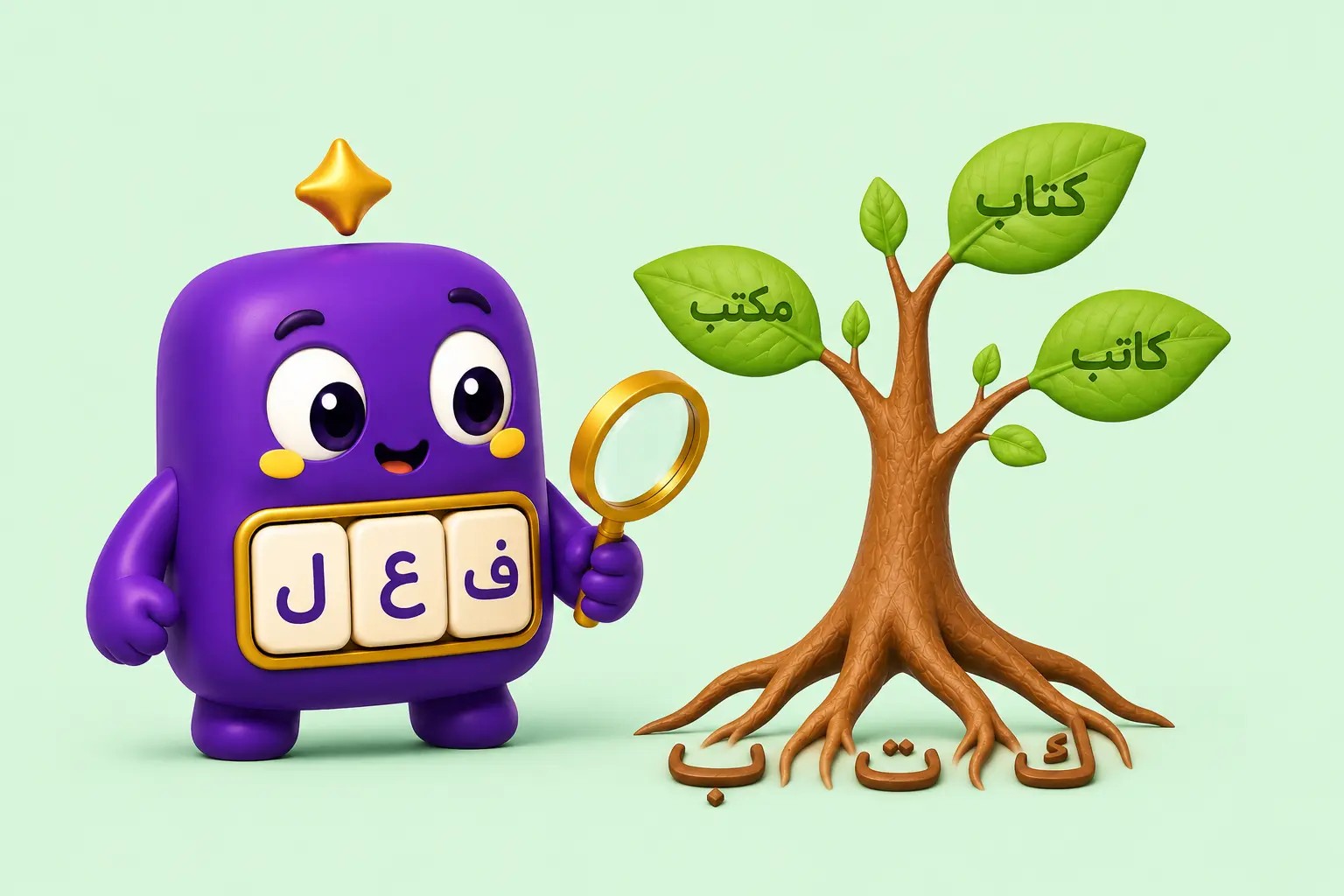
A large proportion of Arabic vocabulary is built on triliteral roots because Arabic inherited this structure from the Semitic languages. The original letters carry a general field of meaning, then enter different patterns to form verbs, nouns, and adjectives. From ل ع ب, for example, we get لَعِبَ (laʿiba, "to play"), لَاعِبٌ (lāʿibun, "player"), لُعْبَةٌ (luʿbatun, "game or toy"), and مَلْعَبٌ (malʿabun, "playground or stadium"). Not all Arabic words, however, have three root letters.
Introduction
Beginners may see words such as لَعِبَ (laʿiba, "to play"), لَاعِبٌ (lāʿibun, "player"), لُعْبَةٌ (luʿbatun, "game or toy"), and مَلْعَبٌ (malʿabun, "playground or stadium") and treat them as separate vocabulary items that must each be memorized on their own. In fact, these words belong to one family united by three original letters: ل ع ب.
This relationship is the starting point for understanding the triliteral root in Arabic. A root retains a general field of meaning, then enters different templates that change the word's function and meaning. It may produce a verb, a noun for the person performing the action, a noun for the place where it occurs, or a noun for something associated with it.
Building words in this way is known as the root-and-pattern system. Affixes are not always added to the end of a word, as they are in many languages. Vowel marks and additional letters may appear before, between, or after the root letters. This is why Arabic word derivation may seem complicated to someone who looks only at a word's surface form, but it becomes clearer once the learner knows how to separate the root from the pattern.
Even so, the question must be phrased precisely. Not every Arabic word is derived from three letters, and triliteral roots are not the only type found in Arabic. An unaugmented verb may be triliteral or quadriliteral, while an unaugmented noun may have three, four, or five original letters. In words containing six letters or more, some letters may be additional; the length of a word does not mean that it has a six-letter root.
Arabic grammarians did not choose this system or impose it on the language's words. The structure already existed in the language. Morphologists later described it and developed the morphological scale to reveal the relationship between the original letters and the template they enter.
In this article, we will see why triliteral roots became the predominant structure, how three letters can produce a broad family of words, and where this principle ends and its exceptions begin. We will use one main root throughout so that the idea remains clear from beginning to end.
What Does It Mean for a Word to Be Derived from Three Letters?
When we say that an Arabic word is derived from three letters, we do not mean that the word contains only those letters. We mean that three of its letters are original elements repeated in other words connected to it in meaning.
Consider the root ل ع ب. These letters do not represent a spoken word. They indicate the original material that appears in a family of words associated with playing.
| Word | Pronunciation | English meaning | Relationship to the root |
|---|---|---|---|
| لَعِبَ | laʿiba | to play | performing the action of playing |
| لَعِبٌ | laʿibun | play or playing | the action of playing |
| لَاعِبٌ | lāʿibun | player | the person who plays |
| لَاعِبَةٌ | lāʿibatun | female player | the woman who plays |
| لُعْبَةٌ | luʿbatun | game or toy | an activity involving play, or something played with |
| أَلْعَابٌ | alʿābun | games or toys | plural of لُعْبَة |
| مَلْعَبٌ | malʿabun | playground or stadium | the place where play occurs |
The letters lām, ʿayn, and bāʾ remain present, while the vowel marks change or additional letters enter to form words with different functions.
Why Does the Triliteral Root Predominate in Arabic?
There is no known historical event in which speakers decided that the roots of their language should contain three letters. Languages are not usually created according to a prior design; their systems form and change over long periods.
The abundance of triliteral roots in Arabic is connected to two basic facts.
Arabic Is a Semitic Language
Arabic belongs to the Semitic language family, which is known for building a large part of its vocabulary from consonantal roots interwoven with morphological templates.
Semitic roots most often consist of three consonants, although longer roots also exist. This structure therefore did not arise in Arabic alone. Arabic inherited it from an older linguistic history, then preserved it and developed its derivational possibilities.
The Triliteral Root Is Highly Productive
A set of three letters can enter multiple patterns, producing many words without losing the semantic connection among them.
This explains the capacity of the triliteral root in Arabic to organize broad areas of the lexicon. This capacity, however, describes the system's efficiency; it does not prove that three was deliberately selected as the most suitable number.
Did Arabic Grammarians Choose This System?
Arabic grammarians did not invent roots or patterns. They described relationships they observed among words in actual use.
Morphologists used the letters ف ع ل as a scale for triliteral words:
| Letter position | Morphological term | Corresponding letter in ل ع ب |
|---|---|---|
| First letter | Fāʾ al-kalima (فاء الكلمة) | ل |
| Second letter | ʿAyn al-kalima (عين الكلمة) | ع |
| Third letter | Lām al-kalima (لام الكلمة) | ب |
When we analyze لَاعِبٌ (lāʿibun, "player"), we find that it follows the pattern فَاعِلٌ:
- Fāʾ corresponds to lām.
- ʿAyn corresponds to ʿayn.
- Lām corresponds to bāʾ.
- The alif belongs to the pattern, not the root.
Likewise:
مَلْعَبٌ ← مَفْعَلٌ مَلْعَبٌ — malʿabun — "playground or stadium"
The mīm belongs to the pattern, while the root is ل ع ب.
The morphological scale is therefore a tool for analyzing a structure that already exists in the language, not a rule used to manufacture words after they appeared.
How Does the Root-and-Pattern System Work?
The root and pattern work together to form a word, and each has a different function.
- The root carries a general semantic field.
- The pattern determines the word's structure and may indicate its function or an aspect of its meaning.
- Context determines the intended meaning in actual use.
| Element | Example | Function |
|---|---|---|
| Root | ل ع ب | connects the word to the field of playing |
| Pattern | فَاعِلٌ | a template used for the active participle of a triliteral verb |
| Word | لَاعِبٌ | a person who plays |
The root alone does not produce a complete word, and the pattern alone does not provide a lexical meaning. A word is formed when the root letters enter the positions of the pattern.
This non-linear relationship is one of the defining features of the root-and-pattern system. The original letters do not always remain a single block with a new ending attached; the elements of the pattern are distributed around and within them.
How Does Arabic Word Derivation Work?
The process can be seen through the ل ع ب family, all connected to the same general field: playing. From the root branch لَعِبَ (laʿiba, "to play"), لَاعِبٌ (lāʿibun, "player"), and مَلْعَبٌ (malʿabun, "playground/stadium"); from لَاعِبٌ branches لُعْبَةٌ (luʿbatun, "game or toy") as well.
The Verb
لَعِبَ الْأَطْفَالُ فِي الْحَدِيقَةِ. Laʿiba al-aṭfālu fī al-ḥadīqati. "The children played in the garden."
The Active Participle
هَذَا لَاعِبٌ مَاهِرٌ. Hādhā lāʿibun māhirun. "This is a skilled player."
The Feminine Noun
هِيَ لَاعِبَةٌ مُحْتَرِفَةٌ. Hiya lāʿibatun muḥtarifatun. "She is a professional player."
The Noun of Place
دَخَلَ الْفَرِيقُ الْمَلْعَبَ. Dakhala al-farīqu al-malʿaba. "The team entered the stadium."
The Noun Referring to an Object
اِخْتَارَ الطِّفْلُ لُعْبَةً جَدِيدَةً. Ikhtāra al-ṭiflu luʿbatan jadīdatan. "The child chose a new toy."
This example shows how Arabic word derivation allows multiple vocabulary items to be built around one general meaning while each word retains its own function.
Is the Root an Independent Word?
The root is not an independent word in ordinary use. When we write ل ع ب, we are displaying the original letters for analytical purposes, but we do not use this form in a sentence.
لَعِبَ (laʿiba, "to play"), however, is a complete word because it has a pattern, vowel marks, and a grammatical function.
| Element | Example | Is it used as an independent word? |
|---|---|---|
| Root | ل ع ب | No |
| Pattern | فَعِلَ | An analytical template |
| Word | لَعِبَ | Yes |
The statement "the root is the original word" is therefore not always precise. A root is an abstract structure extracted by comparing related words; it is not necessarily an old word that was once pronounced independently before other letters were added to it.
Why Is the Root Not Enough to Determine Meaning?
The root guides us toward a semantic field, but it does not provide a complete definition of every word.
- لَعِبَ — laʿiba — "to play"
- لَاعَبَ — lāʿaba — "to play with someone"
- تَلَاعَبَ — talāʿaba — "to manipulate" or "to play around"
- لُعْبَةٌ — luʿbatun — "game or toy"
- مَلْعَبٌ — malʿabun — "playground or stadium"
In some derivatives, the meaning of playing may become figurative:
تَلَاعَبَ التَّاجِرُ بِالْأَسْعَارِ. Talāʿaba al-tājiru bil-asʿāri. "The merchant manipulated the prices."
Here, the verb does not mean that the merchant played a game. It means that he changed or controlled prices improperly. The root reveals the general connection, but the pattern, context, and usage determine the precise meaning.
Do All Arabic Words Have Triliteral Roots?
No. The triliteral base predominates in Arabic, but it is not the only type.
The maximum number of original letters differs between unaugmented verbs and unaugmented nouns.
The Unaugmented Verb
An unaugmented verb is one whose letters are all original. It is divided into:
| Type | Number of original letters | Example | Meaning |
|---|---|---|---|
| Unaugmented triliteral | Three | لَعِبَ | to play |
| Unaugmented quadriliteral | Four | دَحْرَجَ | to roll |
دَحْرَجَ الطِّفْلُ الْكُرَةَ. Daḥraja al-ṭiflu al-kurata. "The child rolled the ball."
The root of دَحْرَجَ is د ح ر ج, and all four letters are original. According to the traditional morphological classification, an unaugmented Arabic verb cannot have five or six original letters.
The Unaugmented Noun
An unaugmented noun may be:
| Type | Number of original letters | Example | Meaning |
|---|---|---|---|
| Unaugmented triliteral | Three | قَمَرٌ | moon |
| Unaugmented quadriliteral | Four | جَعْفَرٌ | Jaʿfar |
| Unaugmented quinqueliteral | Five | سَفَرْجَلٌ | quince |
The letters س ف ر ج ل in سَفَرْجَلٌ (safarjalun, "quince") are considered original in traditional morphological analysis, so the word is described as an unaugmented noun with five original letters.
Are There Bases with Five or Six Original Letters?
Some unaugmented nouns have five original letters, although they are few compared with triliteral structures. An unaugmented six-letter base, however, is not included among the structures of Arabic nouns or verbs in the traditional morphological classification.
Here we must distinguish between the number of original letters and the number of letters in the word after augmentation. The word اِسْتَخْرَجَ contains six letters in writing — ا س ت خ ر ج — but its root does not contain six letters:
- Word: اِسْتَخْرَجَ
- Pronunciation: istakhraja
- Meaning: "to extract"
- Root: خ ر ج
- Pattern: اِسْتَفْعَلَ
- Added letters: ا س ت
اِسْتَخْرَجَ الْعَامِلُ الْمَعْدِنَ مِنَ الْأَرْضِ. Istakhraja al-ʿāmilu al-maʿdina mina al-arḍi. "The worker extracted the mineral from the ground."
A word may therefore contain six letters while having only three original ones.
Are All Arabic Words Derived?
Derivation does not work in the same way across every word in the language.
The derivational system is clearly visible in many verbs, nouns, and adjectives, but some words are not treated by learners as ordinary derivatives. These include:
- أَنَا — anā — "I"
- هَذَا — hādhā — "this"
- فِي — fī — "in"
- مِنْ — min — "from"
There are also non-derived nouns, proper nouns, and Arabized or borrowed words from other languages. Some loanwords may adapt to Arabic structures, but this does not mean that all Arabic words arose from triliteral roots.
Why Is the Root-and-Pattern System Useful to Learners?
It organizes vocabulary. Instead of memorizing لَعِبَ, لَاعِبٌ, لَاعِبَةٌ, لُعْبَةٌ, and مَلْعَبٌ separately, learners can gather them into a single family.
It helps learners anticipate meaning. When learners see مَلْعَبٌ (malʿabun), they can notice the letters ل ع ب and connect the word with playing even before learning its precise translation.
It reveals a word's function. Comparing لَعِبَ (laʿiba, "to play") with لَاعِبٌ (lāʿibun, "player") shows how the pattern turns a verb into a noun denoting the person who performs the action.
It helps with using dictionaries. Many Arabic dictionaries arrange their entries by roots. Knowing the original letters therefore helps learners find a word and view its derivatives in one place.
This is the practical value of the root-and-pattern system: it does not merely explain the structure of words, but also helps learners read, remember, and look them up.
Common Mistakes in Understanding Roots
Confusing the root with the word. The root ل ع ب is an abstract structure, while لَعِبَ is a real word that can be used.
Confusing the length of the word with the length of the root. A word may contain six letters while its root has three, as in اِسْتَخْرَجَ (istakhraja, "to extract").
Removing any letter that appears additional. A letter may be additional in one word and original in another. The mīm is additional in مَلْعَبٌ (malʿabun, "playground"), but it is original in مَلَكَ (malaka, "to possess") — its root is م ل ك.
Predicting the complete meaning from the root. The root identifies a general field, but it does not replace knowledge of the pattern, context, and lexical meaning.
Creating words that are not used. Not every root enters every pattern. A particular form may be theoretically possible but unused in Arabic, or it may carry a meaning that cannot be predicted from the template alone.
Understanding Arabic word derivation helps learners discover words, but it does not give them license to produce any form they want without consulting documented usage.
Did You Know?
A word may be long while its root is clear and short. Another word may be short while identifying its root requires greater morphological knowledge.
The verb اِسْتَعْمَلَ (istaʿmala, "to use") contains six letters, but its root is ع م ل.
The verb قَالَ (qāla, "to say") contains three written letters, but its root is ق و ل. The wāw does not appear in the past-tense form قَالَ because of weak-letter changes, but it appears in قَوْلٌ (qawlun, "saying").
This shows that the number of visible letters alone is not enough to identify the root.
Summary
- The triliteral base predominates in Arabic, but it is not the only structure.
- The triliteral root in Arabic is part of the language's Semitic heritage.
- The root carries a general semantic field, while the pattern gives the word its structure.
- An unaugmented verb may be triliteral or quadriliteral.
- An unaugmented noun may have three, four, or five original letters.
- Traditional morphology recognizes no unaugmented Arabic noun or verb with six original letters.
- A word may contain six letters or more because of additional letters.
- Not all Arabic words are derived in the same way.
- Arabic word derivation connects vocabulary and makes it easier to organize.
- The root-and-pattern system does not work apart from context and real usage.
Frequently Asked Questions
Do Most Arabic Words Contain Only Three Letters?
No. A word may contain four, five, or more letters while its root consists of three original letters. مَلْعَبٌ (malʿabun, "playground"), for example, contains an additional mīm, but its root is ل ع ب.
Are All Arabic Roots Triliteral?
No. Quadriliteral roots occur in nouns and verbs, and some unaugmented nouns have five original letters. The triliteral base, however, is the most common and productive.
Are There Five- or Six-Letter Verbs?
Some verb forms contain five or six letters, but not all their letters are original. An unaugmented Arabic verb can only be triliteral or quadriliteral.
Is There Such a Thing as an Unaugmented Five-Letter Noun?
Yes. One example is سَفَرْجَلٌ (safarjalun, "quince"). Its five letters are considered original in traditional morphological analysis.
Is There an Original Six-Letter Root?
Traditional Arabic morphology does not establish an unaugmented Arabic noun or verb with six original letters. A word may reach six letters because of augmentation.
Why Are the Letters ف ع ل Used in the Morphological Scale?
Morphologists used these letters to represent the positions of a triliteral root: fāʾ for the first letter, ʿayn for the second, and lām for the third.
Does a Root Carry a Specific Meaning?
It usually carries a general semantic field, but the precise meaning is determined by the word, its pattern, and its context of use.
Does Understanding the Triliteral Root in Arabic Help with Vocabulary Learning?
Yes. It allows learners to group words into families, notice their connections, and anticipate aspects of their meanings. It does not, however, remove the need to learn each word in a real context.
The Rooto Word-Family Challenge
Go to the Rooto Machine and press SPIN until a random root and one of its derivatives appear.
Write down the derivative, then try to find two other words belonging to the same family. Afterward, review the pattern, example, and translation displayed by the machine, and compare the derivative's function with the functions of the words you found.
This time, the goal is not merely to identify the root, but to build a small family around it. When you can connect three correct derivatives to a single root, you have begun to see the system behind the vocabulary instead of memorizing every word separately.
If you would like to review the difference between a root and a pattern before the challenge, read What Is an Arabic Root? A Beginner's Guide.
References
- Ibn Iyās. Sharḥ al-Taʿrīf bi-Ḍarūrī al-Taṣrīf. Edited, annotated, and studied by Hādī Nahr and Hilāl Nājī al-Muḥāmī. Dār al-Fikr for Printing, Publishing, and Distribution, Jordan, 1st ed., 1422 AH/2002 — the book defines the root as: "the letters that are essential to the word in whatever form it takes".
- Dendane, Zoubir. (2007). "An Overview of Verb Morphology in Arabic." Revue Maghrébine des Langues — the paper's abstract notes that "Arabic morphology displays three types of affixation to the verb-root".