Quick Answer
To find the root of an Arabic word, carefully remove any attached particles and inflectional endings, return the word to its simplest dictionary form, identify its morphological pattern, and match its letters to ف ع ل.
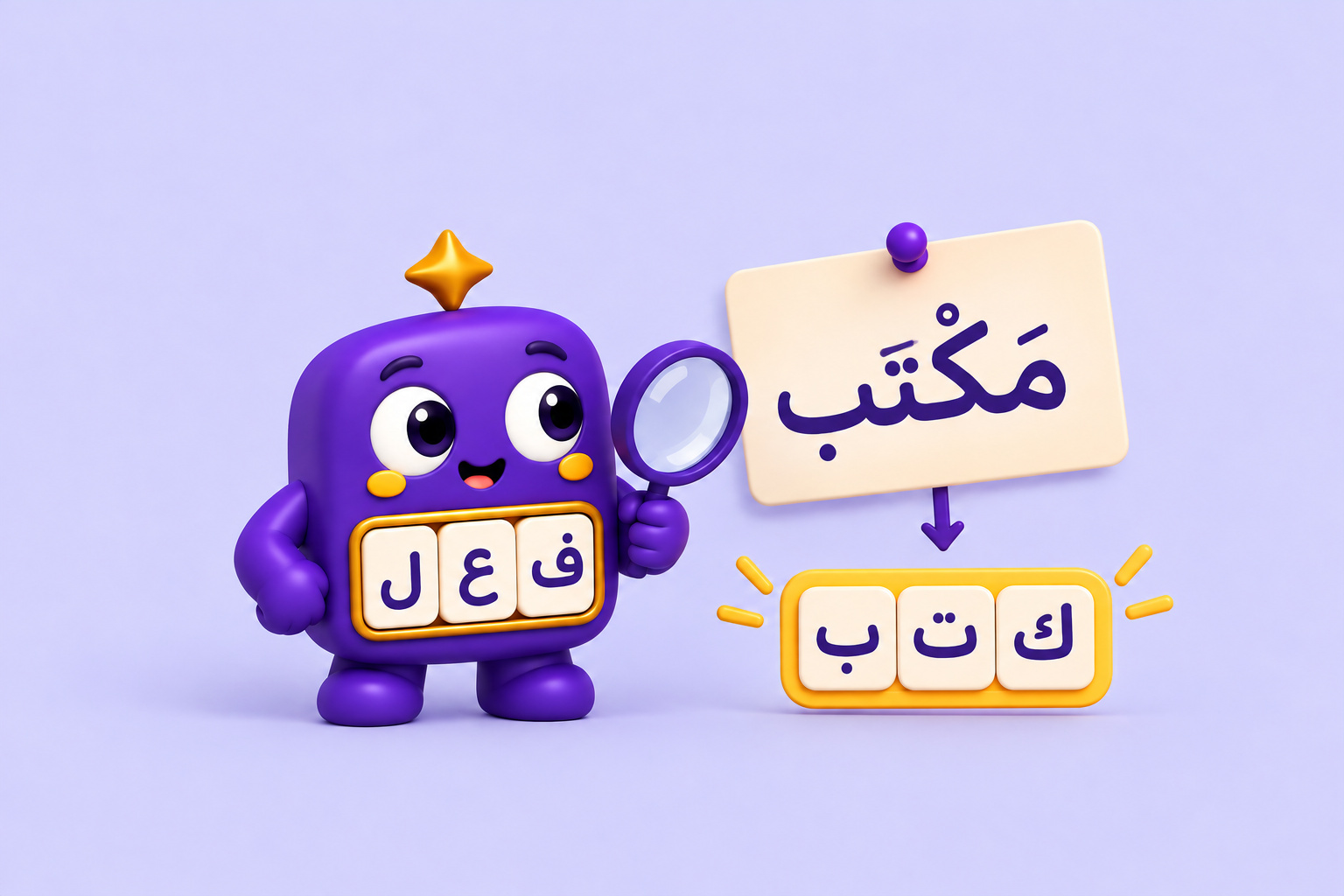
Pay close attention to weak letters, doubled consonants, and hamzah, as an original root letter may have been omitted or changed. For example, مَفَاتِيح (mafātīḥ, keys) returns first to the singular مِفْتَاح (miftāḥ, key) and then to the root ف ت ح. Finally, verify your result in a dictionary arranged by roots.
Introduction
Finding a root may seem straightforward when the word is فَتَحَ (fataḥa, to open), since the original letters are clearly visible: ف ت ح. But what happens when you encounter مَفَاتِيح (mafātīḥ, keys), اِتِّصَال (ittiṣāl, communication), قَائِل (qāʾil, speaker), or شَدَّ (shadda, to pull tightly)? In these cases, simply removing a few letters and keeping what remains will not work.
The difficulty lies in the fact that an Arabic word root may not appear in its complete original form within the word. A weak letter may change, disappear, or turn into a hamzah, while two identical consonants may merge into a single letter marked with a shaddah. Prefixes and suffixes indicating definiteness, conjunction, plurality, or possession may also surround the root, leading beginners to mistake them for original letters.
Finding Arabic roots, therefore, does not mean deleting every alif, tāʾ, mīm, or sīn that appears in a word. These letters may be additional in one word but original in another. The mīm is additional in مَفْتُوح (maftūḥ, open), but original in مَلَكَ (malaka, to possess). The tāʾ is additional in تَعَلَّمَ (taʿallama, to learn), but original in تَرَكَ (taraka, to leave).
The tool that helps us distinguish between original and additional letters is the Arabic morphological pattern. We match the original root letters to ف, ع, and ل while leaving additional letters in their positions. When we match مَفْتُوح to مَفْعُول, for example, we can see that the mīm and wāw belong to the structure, while ف, ع, and ل correspond to the root letters ف ت ح. (The scale is explained in morphological forms and word patterns in Arabic.)
Even so, the pattern alone is not sufficient in every case. Weak, hamzated, and doubled words require us to restore a letter to its original form. The present tense, verbal noun, singular form, or another member of the word family may help reveal that form.
In this article, we will follow a practical method that begins by removing attached particles and endings, returning the word to its dictionary form, identifying its pattern, accounting for phonological changes, and finally checking the result in a dictionary. The article also includes a clear flowchart that you can consult whenever you analyze a new word.
What Is an Arabic Root?
A root is a group of original letters shared by a family of words. These letters generally carry a broad semantic field. (For a fuller introduction, see what an Arabic root is.)
Consider the following words:
- فَتَحَ (fataḥa, to open)
- فَتْح (fatḥ, opening)
- فَاتِح (fātiḥ, opener)
- مَفْتُوح (maftūḥ, open)
- مِفْتَاح (miftāḥ, key)
The patterns and functions differ, but the letters ف ت ح appear throughout the family.
This does not mean that the root provides a complete and detailed meaning. The meaning of مِفْتَاح is not identical to that of فَتْح, although both are connected to the idea of opening. The root connects words within a family, while the pattern and context determine the meaning and use of each individual word. This division of labor is the subject of root vs. pattern.
Most Arabic roots encountered by beginners are triliteral, but Arabic also contains quadriliteral roots, such as د ح ر ج in:
دَحْرَجَ الطِّفْلُ الكُرَةَ. Daḥraja al-ṭiflu al-kurata. "The child rolled the ball."
Not every word should therefore be forced into a triliteral root. The two types are compared in triliteral vs. quadriliteral Arabic roots.
What Is the Difference Between a Root and a Base Word?
It is important to distinguish between a root and the dictionary form, or lemma, of a word.
Consider the verb:
اِسْتَقْبَلَ — istaqbala — to receive
Its dictionary form is اِسْتَقْبَلَ itself: the third-person masculine singular form in the past tense. Its root, however, is:
ق ب ل
Now consider the noun:
مُسَافِرُونَ — musāfirūna — travellers
We can first remove the sound masculine plural ending to reach:
مُسَافِر — musāfir — traveller
مُسَافِر is not the root. It is a derived singular word whose root is:
س ف ر
This intermediate stage is extremely important. In many cases, we cannot move directly from the visible word to the root. We must first return the word to a clearer form.
Why Are Some Roots Difficult to Identify?
The root may be concealed for one or more of the following reasons:
| Source of Difficulty | Example | What Happened? |
|---|---|---|
| Prefixes and suffixes | وَبِالمَدْرَسَةِ | The conjunction وَ, the preposition بِ, and the definite article الـ were added |
| Plural formation | مَفَاتِيح | The internal structure of the singular مِفْتَاح changed |
| Additional letters | اِسْتَخْرَجَ | Alif, sīn, and tāʾ were added |
| A weak letter | قَائِل | The original wāw changed into a hamzah |
| Doubling | شَدَّ | Two dāls merged under one shaddah |
| Assimilation and substitution | اِتَّصَلَ | The wāw changed within the pattern |
| A quadriliteral root | دَحْرَجَ | The root contains four original letters |
These cases explain why the method "remove the additional letters and keep whatever remains" does not always succeed. You must first determine what type of change has affected the word.
What Are the Basic Steps for Finding a Root?
1. Understand the Word's Meaning in Context
Meaning helps prevent confusion between words that look similar, while context determines the intended sense.
حَضَرَ الطَّالِبُ الدَّرْسَ. Ḥaḍara al-ṭālibu al-darsa. "The student attended the lesson."
The verb حَضَرَ (ḥaḍara, to attend) belongs to the root:
ح ض ر
2. Remove Obvious Grammatical Attachments
Conjunctions, prepositions, the definite article, pronoun suffixes, and plural endings may be attached to a word.
Consider:
وَبِمَلْعَبِهِمْ — wa-bi-malʿabihim — and in their playground
We can separate:
- وَ (wa, and)
- بِـ (bi-, in)
- ـهِمْ (-him, their)
What remains is:
مَلْعَب — malʿab — playground
We then match it to the pattern مَفْعَل and reach the root:
ل ع ب
This step requires caution. A letter is not automatically additional simply because it resembles a familiar prefix.
3. Return the Noun to Its Singular Form
If the word is dual or plural, return it to the singular before continuing the analysis.
مُعَلِّمَات — muʿallimāt — female teachers ↓ مُعَلِّمَة — muʿallimah — female teacher ↓ مُعَلِّم — muʿallim — teacher ↓ Root: ع ل م
A broken plural may require you to identify the singular form through context or a dictionary.
4. Return the Verb to the Third-Person Masculine Singular Past
If the verb is in the present tense, imperative, or attached to a pronoun, return it to the third-person masculine singular past tense.
يَسْتَخْدِمُونَ — yastakhdimūna — they use ↓ اِسْتَخْدَمَ — istakhdama — he used ↓ Pattern: اِسْتَفْعَلَ ↓ Root: خ د م
The verb forms behind such patterns are explained in Arabic verb forms explained.
5. Identify the Morphological Pattern
Match the presumed original letters to ف ع ل.
مَحْفُوظ ↓ مَفْعُول
The letters correspond as follows:
- ف corresponds to ح
- ع corresponds to ف
- ل corresponds to ظ
The root is therefore:
ح ف ظ
6. Restore Changed Letters to Their Original Form
If the word contains an alif, hamzah, or shaddah, you may need to consult the present tense, verbal noun, or another member of the family.
قَالَ (qāla, to say) يَقُولُ (yaqūlu, he says)
The appearance of wāw in the present tense reveals that the root is:
ق و ل
7. Verify the Result in a Dictionary
Your analysis gives you a likely answer, but the dictionary confirms the root and meaning. This step is particularly important with weak words, substituted letters, and words that permit more than one possible analysis.
A Flowchart for Finding an Arabic Word Root
The following flowchart is based on the processes of removing additional elements, applying morphological patterns, and analyzing sound and weak words as presented in Arabic morphology books and descriptive references, particularly ʿAbduh al-Rājiḥī's Al-Taṭbīq al-Ṣarfī and Ryding's A Reference Grammar of Modern Standard Arabic.
This flowchart does not mean that every word passes through the same steps. A simple word may allow you to move directly to its pattern. Another word may require its singular form, present tense, and a dictionary before its original root becomes clear.
How Do We Find the Root of a Word with Prefixes and Suffixes?
Let us analyze:
وَبِالمُسْتَخْرَجَاتِ — wa-bi-al-mustakhrajāti — and in the extracted items
Step One: Separate the Attached Elements
- وَ (wa, and)
- بِـ (bi-, in)
- الـ (al-, the)
- ـات (-āt, feminine plural ending)
What remains is:
مُسْتَخْرَج — mustakhraj — extracted
Step Two: Identify the Pattern
The pattern of مُسْتَخْرَج is:
مُسْتَفْعَل
The letters corresponding to ف ع ل are:
خ ر ج
The root is therefore:
خ ر ج
We did not remove the mīm, sīn, and tāʾ at random. We first recognized the pattern and then identified the original letters.
How Do We Find the Root of a Broken Plural?
A broken plural changes the internal structure of the word, so returning to the singular is an essential step.
Example One: مَفَاتِيح
مَفَاتِيح — mafātīḥ — keys
The singular is:
مِفْتَاح — miftāḥ — key
Through the word family:
- فَتَحَ (fataḥa, to open)
- فَتْح (fatḥ, opening)
- مَفْتُوح (maftūḥ, open)
we reach the root:
ف ت ح
Example Two: مَوَاعِيد
مَوَاعِيد — mawāʿīd — appointments
The singular is:
مَوْعِد — mawʿid — appointment
We compare it with the verb:
وَعَدَ — waʿada — to promise
The root becomes clear:
و ع د
This example shows that the wāw in مَوْعِد is not an additional letter. It is the first letter of the root.
How Do We Find the Root of a Weak Word?
A weak root contains a wāw or yāʾ. This weak letter may change or disappear in certain derivatives. The full mechanics are covered in weak Arabic roots explained.
قَائِل
قَائِل — qāʾil — speaker
A beginner may assume that the hamzah is original. However, the verb is:
قَالَ — qāla — to say
Its present tense is:
يَقُولُ — yaqūlu — he says
Its verbal noun is:
قَوْل — qawl — saying
The appearance of wāw reveals the root:
ق و ل
بَائِع
بَائِع — bāʾiʿ — seller
The verb is:
بَاعَ — bāʿa — to sell
Its present tense is:
يَبِيعُ — yabīʿu — he sells
Its verbal noun is:
بَيْع — bayʿ — sale
The root is therefore:
ب ي ع
For this reason, not every hamzah appearing in the pattern فَائِل should be treated as an original root letter.
How Do We Find the Root of a Doubled Word?
A shaddah represents two identical consonants: the first is vowelless and the second carries a vowel.
Consider:
شَدَّ — shadda — to pull tightly
We mentally separate the shaddah:
شَدْدَ
The original letters then become visible:
ش د د
The word family confirms this:
- شَدّ (shadd, pulling or tightening)
- شَدِيد (shadīd, strong or severe)
- تَشْدِيد (tashdīd, intensification)
The same applies to:
مَرَّ — marra — to pass ↓ م ر ر
The shaddah is not a decorative mark. It represents a complete consonant that must be counted when finding Arabic roots.
How Do We Find the Root of a Hamzated Word?
If the hamzah appears in different written forms across related words, it may be an original root letter. See hamzated Arabic roots explained for the full picture.
Consider:
- سَأَلَ (saʾala, to ask)
- سُؤَال (suʾāl, question)
- سَائِل (sāʾil, asker)
- مَسْأَلَة (masʾalah, issue or problem)
Although the supporting letter, or "seat," of the hamzah changes, the hamzah remains the middle letter of the root:
س أ ل
Now consider:
- قَرَأَ (qaraʾa, to read)
- قِرَاءَة (qirāʾah, reading)
- قَارِئ (qāriʾ, reader)
- مَقْرُوء (maqrūʾ, read)
The root is:
ق ر أ
A change in the written form of the hamzah does not change its position within the root.
How Do We Handle Substitution and Assimilation?
This is one of the most difficult stages because a root letter may not appear in its expected form.
اِتَّصَلَ
اِتَّصَلَ — ittaṣala — to contact; connect
The visible form may suggest that the root begins with tāʾ. Related words, however, include:
- وَصَلَ (waṣala, to arrive or connect)
- وَصْل (waṣl, connection)
- صِلَة (ṣilah, connection or relationship)
- اِتِّصَال (ittiṣāl, communication or contact)
The root is therefore:
و ص ل
The root entered the pattern اِفْتَعَلَ, and the interaction between the wāw and tāʾ, together with assimilation, produced the form اِتَّصَلَ.
اِتَّسَعَ
اِتَّسَعَ — ittasaʿa — to become spacious; expand
Related words include:
- وَاسِع (wāsiʿ, wide)
- سَعَة (saʿah, spaciousness or capacity)
- تَوْسِيع (tawsīʿ, expansion)
These words reveal the root:
و س ع
In such cases, the visible form is not enough. You must consult the word family and a dictionary.
When Is a Root Quadriliteral?
Not every Arabic root is triliteral. If four original letters remain after the additional elements are removed, and all four consistently appear across the word family, the root may be quadriliteral.
دَحْرَجَ
دَحْرَجَ — daḥraja — to roll
Its family includes:
- دَحْرَجَة (daḥrajah, rolling)
- مُدَحْرَج (mudaḥraj, rolled)
- يُدَحْرِجُ (yudaḥriju, he rolls)
The original letters are:
د ح ر ج
The pattern is:
فَعْلَلَ
بَعْثَرَ
بَعْثَرَ — baʿthara — to scatter
Its family includes:
- بَعْثَرَة (baʿtharah, scattering)
- مُبَعْثَر (mubaʿthar, scattered)
The root is:
ب ع ث ر
One common mistake is deleting one of these letters in an attempt to force the word into a triliteral root that does not exist.
Complete Analysis of Five Words
| Word | Simplified Form | Pattern or Evidence | Root |
|---|---|---|---|
| وَبِمَلْعَبِهِمْ (wa-bi-malʿabihim, and in their playground) | مَلْعَب (malʿab, playground) | مَفْعَل | ل ع ب |
| مُسَافِرُونَ (musāfirūna, travellers) | مُسَافِر (musāfir, traveller) | مُفَاعِل | س ف ر |
| مَفَاتِيح (mafātīḥ, keys) | مِفْتَاح (miftāḥ, key) | فَتَحَ، مَفْتُوح | ف ت ح |
| قَائِل (qāʾil, speaker) | قَالَ (qāla, to say) | يَقُولُ، قَوْل | ق و ل |
| شَدَّ (shadda, to pull tightly) | شَدْدَ | Separating the shaddah | ش د د |
The table shows that the method varies according to the type of word. The first requires attached elements to be separated, the second requires the plural ending to be removed, the third requires the singular form, the fourth requires the weak letter to be restored, and the fifth requires the doubled consonant to be separated.
Common Mistakes When Finding Arabic Roots
Deleting Every Letter in سَأَلْتُمُونِيهَا
The letters traditionally identified as possible additional letters are collected in the mnemonic word سَأَلْتُمُونِيهَا. However, the presence of one of these letters does not mean that it is always additional.
In سَأَلَ, the sīn, hamzah, and lām are all original.
In مَلَكَ, the mīm is original.
In وَعَدَ, the wāw is original.
In نَزَلَ, the nūn is original.
The mnemonic helps you notice possibilities, but it does not replace the pattern, meaning, or dictionary.
Removing الـ from Every Word Beginning with Alif and Lām
In الكِتَاب, الـ is the definite article. Words should not, however, be analyzed by their visible form alone. You must first confirm that the alif and lām genuinely form the definite article and are not part of another word structure or a proper name.
Treating a Plural as Though It Were Singular
You will not easily reach the root of مَفَاتِيح if you try to match the plural directly to a pattern. Returning to مِفْتَاح makes the analysis clearer.
Ignoring the Shaddah
If you count شَدَّ as consisting only of shīn and dāl, you will lose the third root letter. The shaddah represents two dāls.
Assuming That Alif Is Always Original
The alif in قَالَ developed from wāw, while the alif in بَاعَ developed from yāʾ. Consult the present tense or verbal noun to identify the original letter.
Confusing the Root with the Pattern
In اِسْتَقْبَلَ (istaqbala, to receive), the root is not ا س ت ق ب ل. The root is ق ب ل, while اِسْتَفْعَلَ is the pattern.
Summary
- Finding an Arabic word root begins with understanding the word's meaning in context.
- Carefully separate conjunctions, prepositions, the definite article, pronouns, and plural endings.
- Return nouns to the singular and verbs to the third-person masculine singular past tense.
- Use the Arabic morphological pattern to distinguish original letters from additional ones.
- Do not remove the letters of سَأَلْتُمُونِيهَا automatically; any of them may be original.
- Consult the present tense or verbal noun to identify the origin of an alif or hamzah.
- Separate a shaddah into two consonants when analyzing a doubled verb.
- Do not assume that every root is triliteral; Arabic also has quadriliteral roots.
- Finding Arabic roots becomes more accurate when you combine the pattern, meaning, and word family.
- Always verify your result in a reliable dictionary.
Frequently Asked Questions
Can I Find the Root of Any Word by Removing the Additional Letters?
No. You must identify the pattern first because a letter that is additional in one word may be original in another. The mīm is additional in مَكْتَب but original in مَلَكَ.
What Is the Difference Between a Root and a Stem?
The root is the set of original letters, such as خ د م. The stem is a form to which inflectional endings may be added. مُسْتَخْدِم (mustakhdim, user), for example, may function as a stem in computational analysis, but it is not the morphological root.
How Can I Identify the Original Letter Behind an Alif in the Middle of a Verb?
Consult the present tense or verbal noun. يَقُولُ (yaqūlu, he says) reveals that the alif in قَالَ originates from wāw. يَبِيعُ (yabīʿu, he sells) reveals that the alif in بَاعَ originates from yāʾ.
Is the Hamzah in an Active Participle Always Original?
No. The hamzah in سَائِل (sāʾil, asker) is original because the root is س أ ل. The hamzah in قَائِل (qāʾil, speaker), however, results from a change affecting the original wāw, and the root is ق و ل.
What Should I Do If the Word Is a Broken Plural?
Return it to the singular first. مَفَاتِيح (mafātīḥ, keys) returns to مِفْتَاح (miftāḥ, key) and then to the root ف ت ح.
How Can I Tell Whether a Root Is Quadriliteral?
If four letters remain consistent across the word family and none of them is additional, the root may be quadriliteral. An example is د ح ر ج in دَحْرَجَ (daḥraja, to roll).
Which Dictionary Is Best for Verifying a Root?
You can consult Al-Muʿjam al-Wasīṭ or another reliable Arabic dictionary arranged by roots. Search for the proposed original letters, then confirm that the word and its meaning appear under that entry.
Test Your Morphological Eye with Rooto
Go to the Rooto Machine and press SPIN, but do not look immediately at the root displayed. Begin with the derived word and try to complete four steps:
- Separate any clearly additional letters.
- Identify the likely morphological pattern.
- Extract the letters corresponding to ف ع ل.
- Compare your result with the root displayed by Rooto.
Repeat the challenge for three spins. If you make a mistake, do not simply memorize the correct answer. Identify why the mistake happened: Did you treat an original letter as additional? Did you forget to separate the shaddah? Or did the word contain a changed weak letter?
Understanding the reason for the error is what develops your ability to analyze Arabic words. The same habit is behind how Arabic speakers recognize new words.
References Used
- ʿAbduh al-Rājiḥī. Al-Taṭbīq al-Ṣarfī [Applied Arabic Morphology]. Dār al-Nahḍah al-ʿArabiyyah, Beirut, first edition.
- Academy of the Arabic Language in Cairo. Al-Muʿjam al-Wasīṭ [The Intermediate Dictionary]. Al-Shorouk International Library, fourth edition, 2004.
- Ryding, Karin C. A Reference Grammar of Modern Standard Arabic. Cambridge University Press, 2005.