Quick Answer
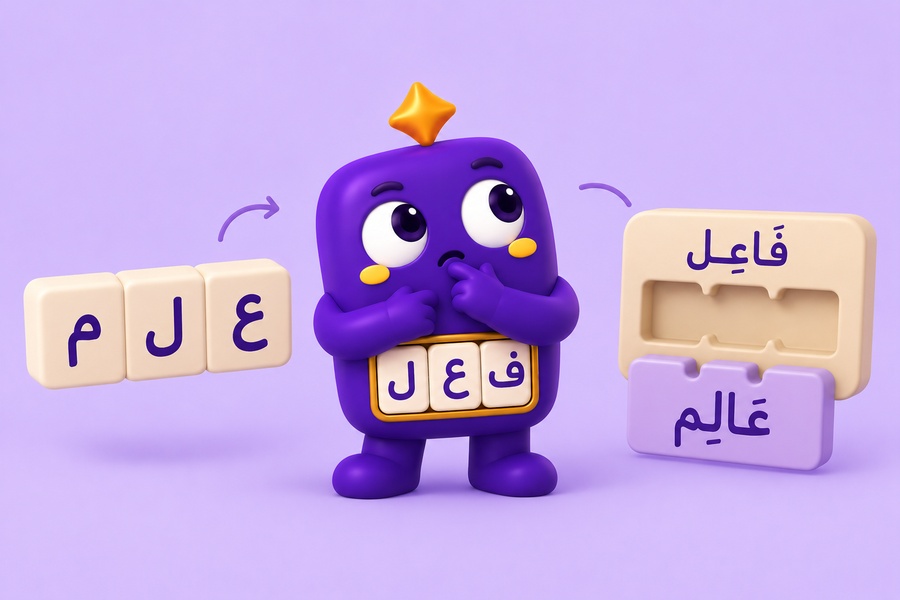
A root is a group of original letters shared by words that usually belong to the same general field of meaning, such as د ر س in دَرَسَ, مَدْرَسَة, and مَدْرُوس. A pattern, on the other hand, is the template into which the root letters are arranged. It may add letters or vowels that give the word a particular structure and morphological meaning. In short, the root supplies the basic material of meaning, while the pattern shows how the word was built.
Introduction
One of the most confusing moments for learners at the beginning of their Arabic journey comes when a teacher says, "The root of this word is د ر س, and its pattern is مَفْعَلَة." The sentence may sound perfectly clear to someone who has studied Arabic morphology before, but it raises a basic question for a beginner: if both the root and the pattern are found inside the same word, what does each one actually do?
This is not a minor theoretical detail. Understanding the Arabic root helps learners uncover connections between words that may look completely different at first. Once you know that دَرَسَ (darasa, "studied"), دَارِس (dāris, "learner/student"), and مَدْرَسَة (madrasa, "school") come from the same root, you no longer need to memorize each word as an entirely separate item.
The root alone, however, does not explain everything. Why does دَارِس (dāris, "learner/student") refer to the person who studies, while مَدْرُوس (madrūs, "studied") describes something that has been studied? This is where the morphological pattern comes in. It reveals the structure taken by the root letters and helps us notice the relationship between a word's form, function, and meaning.
Understanding the difference between a root and a pattern therefore changes the way you learn Arabic vocabulary. Instead of treating the language as one long list of words, you begin to see it as a collection of connected families. Each family has its own original material, and every word within that family has a structure that distinguishes it from the others.
In this article, you will learn what roots and patterns are, how they come together inside a word, how to identify the original letters, and how to determine the morphological template. We will use the د ر س family as our main example so that the comparison remains clear from beginning to end, while bringing in other examples to keep the rule from turning into a mechanical formula.
What Is an Arabic Root?
An Arabic root is a group of original letters that forms the foundation of a family of words connected by a shared core meaning. A root most often consists of three letters, though Arabic also has quadriliteral roots, and its basic noun structures may contain five original letters.
Take the root:
د ر س — d-r-s
Its general field of meaning revolves around studying, learning, and gaining knowledge of something.
These letters appear in several words:
| Arabic word | Pronunciation | English meaning | Relationship to the root |
|---|---|---|---|
| دَرَسَ | darasa | he studied | the act of studying |
| دَرْس | dars | lesson | something that is studied |
| دَارِس | dāris | learner / student | someone who studies |
| مَدْرُوس | madrūs | studied | something upon which the act of studying was performed |
| مَدْرَسَة | madrasa | school | a place of study |
| دِرَاسَة | dirāsa | study | the process of studying |
These words do not mean the same thing, but they share the original letters د ر س and belong to the same general semantic field. That is the root's central role: it connects words to a common lexical origin.
Even so, the meaning of a root should not be treated as a fixed English translation that can replace every derivative. A root generally points to a semantic field or core idea, while the word's form and context help determine its precise meaning. English readers can compare this with how English prefixes and suffixes work, where a base is extended at its edges rather than interwoven with a template.
What Is a Morphological Pattern?
A morphological pattern is a standard template Arabic grammarians use to represent a word's structure. It shows the positions of the original root letters, along with any vowels, additional letters, or consonant doubling added to them.
In triliteral words, the root letters are usually matched with the letters ف ع ل:
| Letter position | Pattern symbol |
|---|---|
| First original letter | فاء الكلمة (fāʾ al-kalima) |
| Second original letter | عين الكلمة (ʿayn al-kalima) |
| Third original letter | لام الكلمة (lām al-kalima) |
If the word is:
دَرَسَ — darasa — "he studied"
we match its letters as follows:
| Word | دَ | رَ | سَ |
|---|---|---|---|
| Pattern | فَ | عَ | لَ |
The pattern of دَرَسَ is therefore:
فَعَلَ — faʿala — basic triliteral verb pattern
Here, فَعَلَ does not mean that we replace the meaning of studying with the general idea of "doing." It is simply a measuring tool that represents the word's structure — a mold into which we can place the letters of different roots.
What Is the Difference Between a Root and a Pattern?
The difference between a root and a pattern can be summarized through two questions:
- Which original letters does the word belong to? That is a question about the root.
- How are those letters arranged inside the word? That is a question about the pattern.
| Point of comparison | Root | Pattern |
|---|---|---|
| Function | carries the shared lexical core | describes the structure of the word |
| Form | original letters such as د ر س | a template such as فَاعِل or مَفْعُول |
| What changes? | changes from one word family to another | may recur across many different roots |
| What does it reveal? | the word's connection to its family | the arrangement of letters, additions, and vowels |
| Example | د ر س | مَفْعَلَة |
| Result | the word family related to studying | مَدْرَسَة, a noun built on this pattern |
You can think of the root as the material you are working with and the pattern as the way that material is arranged. If the root changes while the pattern remains the same, the result is a new word with a similar structure but a different lexical meaning.
For example:
- دَارِس (dāris, "learner/student"): the root is د ر س, and the pattern is فَاعِل.
- لَاعِب (lāʿib, "player"): the root is ل ع ب, and the pattern is فَاعِل.
- سَابِح (sābiḥ, "swimmer"): the root is س ب ح, and the pattern is فَاعِل.
The roots differ, but all three words share the pattern فَاعِل (fāʿil, the active-participle pattern). In these examples, that pattern refers to the person who performs the action.
Why Did Arabic Grammarians Choose the Letters ف ع ل?
Arabic morphologists chose the letters ف ع ل as the basis of the morphological scale because they form a three-letter sequence and because triliteral roots are so common in Arabic. The first letter of a word is matched with fāʾ, the second with ʿayn, and the third with lām.
For example:
لَعِبَ — laʿiba — "he played"
is weighed as follows:
- ل corresponds to ف.
- ع corresponds to ع.
- ب corresponds to ل.
- The vowels are carried over exactly as they appear.
Its pattern is therefore:
فَعِلَ — faʿila — a basic triliteral verb pattern
Notice that the pattern here is فَعِلَ, not فَعَلَ, because the vowel on the second letter of لَعِبَ is a kasra. The morphological scale records more than the number of letters; it also preserves the order of the vowels visible in the form.
With a quadriliteral root, another ل is added to the pattern. The word:
دَحْرَجَ — daḥraja — "he rolled something"
has the pattern:
فَعْلَلَ — faʿlala — basic quadriliteral verb pattern
How Do the Root and Pattern Come Together Inside a Word?
A derived word is formed when the root letters enter a particular morphological template. We can represent the process simply:
| Root | Pattern | Resulting word |
|---|---|---|
| د ر س | فَعَلَ | دَرَسَ |
| د ر س | فَاعِل | دَارِس |
| د ر س | مَفْعُول | مَدْرُوس |
| د ر س | مَفْعَلَة | مَدْرَسَة |
| د ر س | فِعَالَة | دِرَاسَة |
How Do You Identify the Root of a Word?
To identify a root, begin with a clear word, then look for other words close to it in meaning and structure. Compare them and determine which letters remain constant.
Take the word:
مَدْرُوس — madrūs — "studied"
and compare it with:
- دَرَسَ (darasa, "he studied")
- دَرْس (dars, "lesson")
- دَارِس (dāris, "learner/student")
- دِرَاسَة (dirāsa, "study")
The letters that appear in the same order are:
د ر س
The م at the beginning of مَدْرُوس and the و after the ر are not part of this root.
For a beginner, this comparison is more reliable than removing letters mechanically, because the same letter may be original in one word and additional in another. The م, for instance, is an original letter in:
مَلَكَ — malaka — "he possessed"
whose root is م ل ك, but it is an added letter in:
مَكْتُوب — maktūb — "written"
whose root is ك ت ب.
There is therefore no single list of letters that can always be removed from every word. Knowing the word family and its context is essential for arriving at a correct analysis.
How Do You Determine a Word's Pattern?
Once you have identified the root, you can determine the pattern in four steps:
- Place ف in the position of the first original letter.
- Place ع in the position of the second original letter.
- Place ل in the position of the third original letter.
- Keep all added letters, vowels, and consonant doubling in their original positions.
Apply these steps to:
مَدْرُوس — madrūs — "studied"
| Element of مَدْرُوس | مَ | دْ | رُ | و | س |
|---|---|---|---|---|---|
| Original or added? | added | first original letter | second original letter | added | third original letter |
| Its equivalent in the pattern | مَ | فْ | عُ | و | ل |
The result is:
مَفْعُول — mafʿūl — passive-participle pattern
Here is another example:
دَرَّسَ — darrasa — "he taught"
The middle letter is doubled, so the doubling also appears in the pattern:
فَعَّلَ — faʿʿala — Form II verb pattern
This step demonstrates the difference between a root and a pattern in practical terms. The root in both words is د ر س, but the pattern of مَدْرُوس is different from that of دَرَّسَ.
Does a Pattern Always Carry a Fixed Meaning?
Many patterns are associated with recurring morphological functions or semantic tendencies, but they should not be treated as rigid equations with no exceptions.
The pattern فَاعِل, for example, is commonly used to form the active participle of a triliteral verb:
| Verb | Pronunciation and meaning | Active participle | Pronunciation and meaning |
|---|---|---|---|
| دَرَسَ | darasa — studied | دَارِس | dāris — learner/student |
| لَعِبَ | laʿiba — played | لَاعِب | lāʿib — player |
| سَبَحَ | sabaḥa — swam | سَابِح | sābiḥ — swimmer |
The pattern مَفْعُول, meanwhile, is commonly used to form the passive participle of a transitive triliteral verb:
| Verb | Pronunciation and meaning | Passive participle | Pronunciation and meaning |
|---|---|---|---|
| دَرَسَ | darasa — studied | مَدْرُوس | madrūs — studied |
| فَتَحَ | fataḥa — opened | مَفْتُوح | maftūḥ — open/opened |
| كَسَرَ | kasara — broke | مَكْسُور | maksūr — broken |
These relationships are useful for anticipating a word's function, but its final meaning also depends on lexical usage and context. A pattern offers an important clue, not a complete translation of the word.
Why Does Understanding Roots and Patterns Help with Vocabulary Learning?
When you see a new word such as:
مُسَابَقَة — musābaqa — "competition"
you may not know its meaning immediately, but you can notice its connection to the verb:
سَابَقَ — sābaqa — "he competed with someone"
and to the word:
سِبَاق — sibāq — "race"
You can then trace them back to the root:
س ب ق — s-b-q
associated with going ahead and preceding.
Next, you look at the structure of مُسَابَقَة and identify its pattern:
مُفَاعَلَة — mufāʿala — a verbal-noun pattern commonly associated with Form III
This is how the Arabic root and the pattern work together. The first connects a word to its family; the second reveals its structure and its relationship to the verb from which it was derived.
This skill does not replace the dictionary, but it makes dictionary use far more informed. Instead of looking up every word with no context, you begin by predicting its family and function, then confirm its precise meaning.
What Common Mistakes Do Beginners Make?
1. Assuming the root is a complete word
The root د ر س is not a word used on its own in a sentence. It is a representation of the shared original letters. دَرَسَ (darasa, "he studied"), on the other hand, is a complete word with vowels, a form, and a tense.
2. Confusing the root with the past-tense verb
The past-tense verb may make it easier to identify the root, but the two are not the same:
- Root: ل ع ب
- Past-tense verb: لَعِبَ (laʿiba, "he played")
- Verb pattern: فَعِلَ (faʿila)
3. Removing every letter that looks additional
You should never remove an alif, mīm, or tāʾ without first analyzing the word. A letter may be additional in one word and original in another. Comparing derivatives is the safest approach for beginners.
4. Assuming words on the same pattern come from the same root
دَارِس (dāris, "learner"), لَاعِب (lāʿib, "player"), and كَاتِب (kātib, "writer") all follow the pattern فَاعِل, but they come from three different roots.
5. Assuming that every similarity in letters proves derivation
A visual resemblance between two words is not enough to prove that they belong to the same family. The order of the original letters must remain consistent, and both meaning and the dictionary should be consulted whenever there is doubt.
Does Every Arabic Word Have a Root and a Pattern?
The morphological scale is primarily a tool for analyzing inflected and derived Arabic words. Not every word is therefore treated in the same way.
Particles, such as:
فِي — fī — "in"
pronouns, such as:
هُوَ — huwa — "he"
and many indeclinable and foreign nouns do not enter morphological analysis in the same way as derived words such as دَارِس and مَدْرُوس.
Some Arabic words may also have long histories of usage or structures complicated by weak-letter changes or assimilation, making it difficult for a beginner to identify their origins from their surface forms alone. In such cases, it is better to consult a reliable dictionary than to impose an uncertain analysis.
Did You Know?
A single pattern may appear across hundreds of different word families. When you learn the pattern فَاعِل, you are not learning just one word; you are gaining a key that helps you understand words such as:
- حَافِظ (ḥāfiẓ, "one who memorizes/guardian")
- رَاكِب (rākib, "rider/passenger")
- عَامِل (ʿāmil, "worker")
- شَارِب (shārib, "drinker")
These words do not, however, belong to one family. What they share is a morphological structure, not a root. This observation alone captures an important part of the difference between a root and a pattern.
Summary
- An Arabic root consists of the original letters that connect members of a word family.
- A morphological pattern is the template that shows how a word was built.
- The letters of a triliteral root are usually matched with ف ع ل.
- Added letters, vowels, and consonant doubling are preserved when writing the pattern.
- The root letters may remain the same while the patterns change, producing multiple words.
- The same pattern may recur with different roots.
- A pattern can help you predict a word's function, but it does not always provide its full meaning.
- The best way to practice is to compare real words from a single family.
Frequently Asked Questions
What is the difference between a root and a pattern in one sentence?
The root identifies the original letters shared by a group of words, while the pattern describes the template in which those letters are arranged.
Is the root the same as the past-tense verb?
No. د ر س is the root, while دَرَسَ (darasa, "he studied") is a past-tense verb built on the pattern فَعَلَ.
Does the root change when the pattern changes?
The root remains the same within a single word family, though some of its letters may appear differently because of phonological and morphological processes such as weak-letter changes and assimilation. This is a more advanced stage that requires further analysis.
Can two words share the same pattern but have different roots?
Yes. دَارِس (dāris, "learner") and لَاعِب (lāʿib, "player") both follow the pattern فَاعِل, but the first comes from د ر س and the second from ل ع ب.
Can two words share the same root but follow different patterns?
Yes. دَارِس (dāris, "learner") follows the pattern فَاعِل, while مَدْرُوس (madrūs, "studied") follows مَفْعُول. Both come from the root د ر س.
Is every Arabic root triliteral?
No. Triliteral roots are common, but Arabic also has quadriliteral roots, such as د ح ر ج in دَحْرَجَ (daḥraja, "rolled something"). In traditional Arabic morphology, an unaugmented noun may be triliteral, quadriliteral, or quinqueliteral, while an unaugmented verb may be triliteral or quadriliteral.
How can I tell whether a letter is original or additional?
Compare the word with its derivatives and look for the letters that remain in the same order. If the analysis is still unclear, check it in a reliable Arabic dictionary.
Is the pattern enough to tell me what a word means?
No. A pattern may point to a recurring morphological function or semantic tendency, but the precise meaning comes from the root, the form, the context, and established lexical usage together.
Test the Difference Yourself with Rooto
Go to the Rooto Machine and press SPIN. When the root and derivative appear, cover the pattern for a moment and try to answer two separate questions:
- What are the word's original letters?
- What template were those letters placed into?
Then compare your answer with the pattern shown on the machine, and read the Arabic example and its English translation. Write down three words in which you were able to distinguish the Arabic root from the word's structure on your first attempt. If the two still become confused, return to the article Five Common Arabic Morphological Patterns Every Beginner Should Know and review the function of each template in real words.
References Used
- Dendane, Zoubir. (2007). "An Overview of Verb Morphology in Arabic." Revue Maghrébine des Langues.
- Khaliq, Bilal, and John Carroll. (2013). "Induction of Root and Pattern Lexicon for Unsupervised Morphological Analysis of Arabic." Proceedings of the Sixth International Joint Conference on Natural Language Processing, pp. 1012–1016.