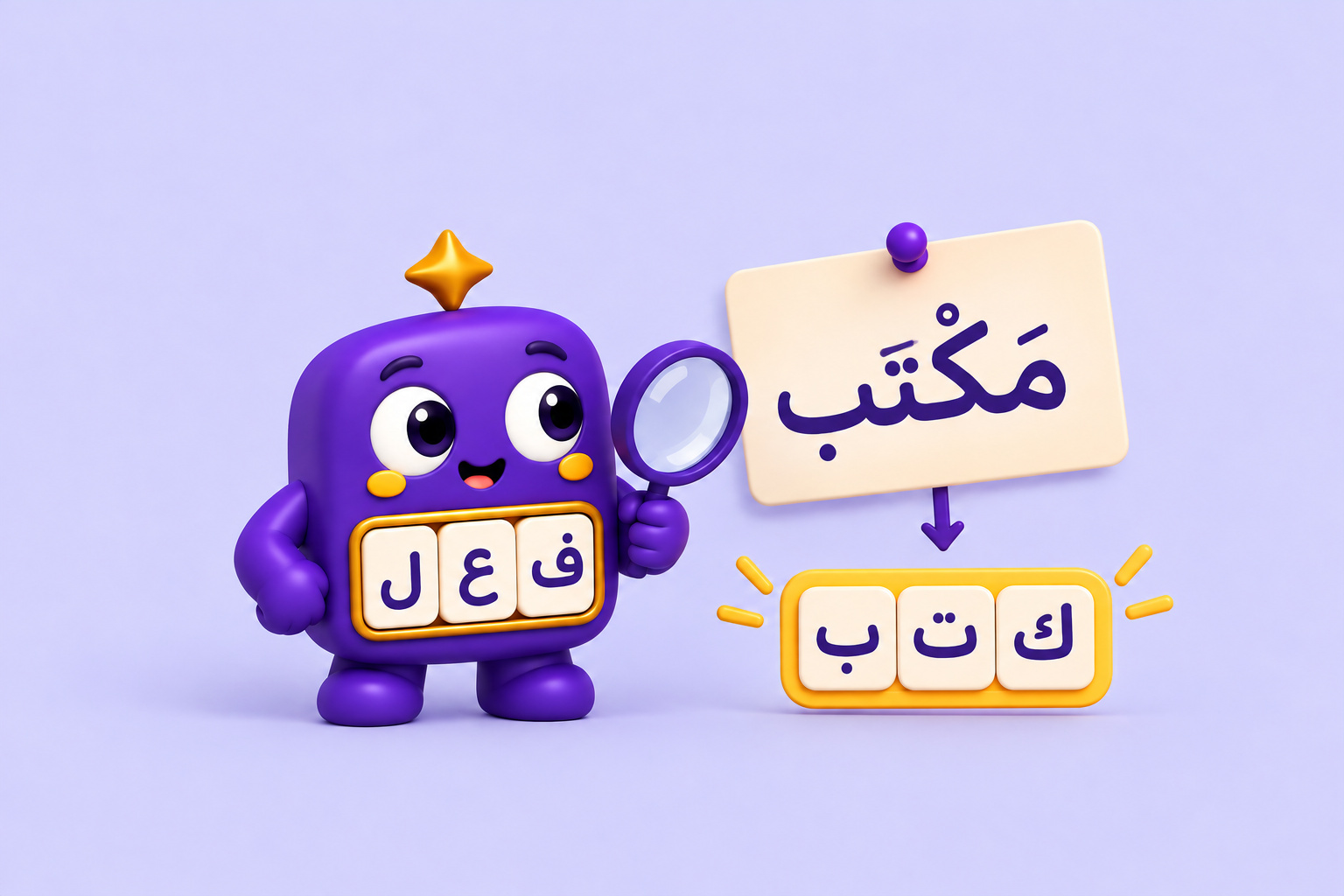
Quick Answer
Arabic words do not belong to the same root simply because they look or sound alike. An alif may conceal a wāw in one word and a yāʾ in another, a shaddah may represent two original consonants, and a single dot may change the root entirely.
For example, عَادَ (ʿāda, returned) comes from the root ع و د, while عَدَّ (ʿadda, counted) comes from ع د د. You must therefore examine the present tense, verbal noun, derivatives, and meaning before identifying a word's root.
Introduction
Two words appear on the board, separated by nothing more than a short vowel, a dot, or a hidden letter. The learner looks at them and quickly decides that they belong to the same word family. The decision seems logical: the words look similar, sound alike, and may even share two or more visible letters. A closer morphological investigation, however, may reveal that each word follows an entirely different path.
This is one of the most common traps beginners encounter when dealing with similar Arabic words. Arabic does not display every original root letter in the same form across all words. A wāw or yāʾ may change into an alif, two identical consonants may merge under a shaddah, and unvowelled writing may make two distinct words look more closely related than they really are.
Consider مَالَ (māla, leaned) and مَال (māl, money). The two words are almost identical in writing, but the verb belongs to the root م ي ل, while the noun belongs to م و ل. Neither the yāʾ nor the wāw appears clearly in the written forms, so learners cannot discover the difference merely by counting letters.
The problem is not limited to weak verbs. Learners may confuse عَادَ (ʿāda, returned) with عَدَّ (ʿadda, counted), or ضَلَّ (ḍalla, went astray) with ظَلَّ (ẓalla, remained). Some of these words are close in sound, some follow a similar pattern, and others differ by a single dot that creates an entirely different morphological and semantic identity.
Studying Arabic word roots therefore cannot begin with visible form alone. We need to examine the present tense, verbal noun, derivatives, and meaning within the sentence. These clues help us distinguish Arabic roots instead of assuming a derivational relationship based only on visual similarity. (If roots are new to you, start with what an Arabic root is.)
In this article, we will not simply present the answers. We will treat the words as case files: examine the two suspects, inspect the evidence, identify the source of the confusion, and then issue a final verdict.
Why Do Some Arabic Words Mislead Us?
The final form of a word consists of several elements:
- Root letters
- The morphological pattern
- Additional letters
- Inflectional markers
- Changes affecting weak letters
- Assimilation represented by a shaddah
- Short vowels that may be omitted from the text
Two words may therefore appear similar even though each was formed in a completely different way.
Finding two shared letters is not enough to place two words in the same family. We must confirm that the letters are original, that their order remains consistent, and that the words' conjugations support the proposed analysis. The full step-by-step method is in how to find the root of any Arabic word.
How Do We Investigate a Word's Root?
Before opening our case files, we need four kinds of evidence.
Evidence One: The Present Tense
The present tense may reveal a weak letter hidden in the past tense:
عَادَ — يَعُودُ ʿāda — yaʿūdu "returned" — "returns"
The appearance of wāw reveals the root ع و د.
Evidence Two: The Verbal Noun
The verbal noun helps restore changed letters to their original forms:
مَالَ — مَيْل māla — mayl "leaned" — "inclination"
The appearance of yāʾ reveals the root م ي ل.
Evidence Three: The Word Family
We should not judge a word from one form alone. We must examine related words:
مَال — أَمْوَال — تَمْوِيل māl — amwāl — tamwīl "money" — "funds" — "financing"
The recurring wāw reveals the root م و ل.
Evidence Four: Meaning and Context
Two words may sound similar, but the way each one functions within a sentence may reveal that they express completely different meanings.
The morphological investigator's rule: Never issue a verdict from the word's visible form alone. Look for evidence in the present tense, verbal noun, plural, or derivatives.
Case File One: مَالَ or مَال?
The Suspects
- مَالَ (māla, leaned)
- مَال (māl, money)
Before You Continue
Do you think the two words belong to the same root?
- Yes, because they look almost identical.
- No, because their word families are different.
- I am not sure yet.
First Impression
The two words look identical when the short vowels are removed, but the alif conceals a different letter in each one.
Examining the First Word
مَالَ الغُصْنُ نَحْوَ النَّافِذَةِ. Māla al-ghuṣnu naḥwa al-nāfidhah. "The branch leaned toward the window."
We examine the present tense:
يَمِيلُ — yamīlu — he leans
Then the verbal noun:
مَيْل — mayl — inclination
The Evidence
- مَالَ
- يَمِيلُ
- مَيْل
The letter that appears in the present tense and verbal noun is yāʾ.
First Verdict
مَالَ ← م ي ل
Examining the Second Word
حَفِظَ الرَّجُلُ مَالَهُ فِي المَصْرِفِ. Ḥafiẓa al-rajulu mālahu fī al-maṣrif. "The man kept his money in the bank."
We examine the word family:
- أَمْوَال (amwāl, funds/money)
- تَمْوِيل (tamwīl, financing)
- مُمَوِّل (mumawwil, financier)
The Evidence
The wāw appears clearly throughout the family.
Second Verdict
مَال ← م و ل
Where Did the Mistake Occur?
The learner relied on the written form and assumed that the alif represented the same original letter in both words. In the first word, however, the alif developed from yāʾ. The second belongs to a family in which wāw appears.
Final Verdict
| Word | Revealing Evidence | Root |
|---|---|---|
| مَالَ (māla, leaned) | يَمِيلُ، مَيْل | م ي ل |
| مَال (māl, money) | أَمْوَال، تَمْوِيل | م و ل |
The morphological investigator's rule: When you see an alif in the middle of a word, do not assume that it is original. Search for a wāw or yāʾ in another form.
Case File Two: عَادَ or عَدَّ?
The Suspects
- عَادَ (ʿāda, returned)
- عَدَّ (ʿadda, counted)
Before You Continue
Which letter is not clearly visible in each word?
Pause for a moment and try to separate the two words before reading the evidence.
Examining the First Word
عَادَ المُسَافِرُ إِلَى بَيْتِهِ. ʿĀda al-musāfiru ilā baytihi. "The traveller returned home."
The present tense:
يَعُودُ — yaʿūdu — he returns
The verbal noun:
عَوْدَة — ʿawdah — return
First Verdict
عَادَ ← ع و د
Examining the Second Word
عَدَّ الطَّالِبُ الكُتُبَ. ʿAdda al-ṭālibu al-kutuba. "The student counted the books."
We separate the shaddah:
عَدْد
Then we examine the family:
- عَدَد (ʿadad, number)
- تَعْدَاد (taʿdād, enumeration/counting)
- مَعْدُود (maʿdūd, counted)
Second Verdict
عَدَّ ← ع د د
Where Did the Mistake Occur?
In the first word, the alif concealed a wāw. In the second, the shaddah concealed a second dāl. Ignoring these two clues makes the words appear more closely related than they are.
Final Verdict
| Word | Hidden Letter | Root |
|---|---|---|
| عَادَ (ʿāda, returned) | Wāw | ع و د |
| عَدَّ (ʿadda, counted) | The second dāl | ع د د |
The morphological investigator's rule: A shaddah is not a decorative vowel mark. It represents two identical consonants, both of which must be counted when finding the root.
Challenge One: Find the Intruder
Which word does not belong to the family?
عَادَ — يَعُودُ — عَوْدَة — عَدَد
Do not look at the solution immediately. Search for the letter that appears repeatedly in the first three words.
Solution
The intruder is:
عَدَد — ʿadad — number
It belongs to the root:
ع د د
The following words:
- عَادَ (ʿāda, returned)
- يَعُودُ (yaʿūdu, returns)
- عَوْدَة (ʿawdah, return)
belong to the root:
ع و د
Case File Three: ضَلَّ or ظَلَّ?
The Suspects
- ضَلَّ (ḍalla, went astray)
- ظَلَّ (ẓalla, remained)
First Impression
The two words have a similar structure, and both contain a doubled lām. The difference between them, however, is not a small vowel change. It is a different original consonant.
Examining the First Word
ضَلَّ المُسَافِرُ الطَّرِيقَ. Ḍalla al-musāfiru al-ṭarīqa. "The traveller lost his way."
After separating the shaddah:
ضَلْل
The root is:
ض ل ل
Other members of the family include:
- ضَلَال (ḍalāl, error/going astray)
- ضَالّ (ḍāll, lost/misguided)
Examining the Second Word
ظَلَّ الطِّفْلُ فِي البَيْتِ. Ẓalla al-ṭiflu fī al-bayt. "The child remained at home."
After separating the shaddah:
ظَلْل
The root is:
ظ ل ل
Where Did the Mistake Occur?
The learner treated ḍād and ẓāʾ as two forms of the same letter because some speakers pronounce them similarly. They are, however, two independent letters, and each word has its own root and meaning.
Final Verdict
| Word | Meaning | Root |
|---|---|---|
| ضَلَّ (ḍalla, went astray) | Became lost or lost the way | ض ل ل |
| ظَلَّ (ẓalla, remained) | Remained or continued | ظ ل ل |
The morphological investigator's rule: A dot is part of a letter's identity. Changing ḍād to ẓāʾ does not merely alter its appearance; it moves the word into another root.
Case File Four: سَأَلَ or سَالَ?
The Suspects
- سَأَلَ (saʾala, asked)
- سَالَ (sāla, flowed)
Before You Continue
Is the alif in both words of the same type?
Examining the First Word
سَأَلَ الطَّالِبُ المُعَلِّمَ سُؤَالًا. Saʾala al-ṭālibu al-muʿallima suʾālan. "The student asked the educator a question."
Other members of the family include:
- سُؤَال (suʾāl, question)
- سَائِل (sāʾil, questioner)
- مَسْأَلَة (masʾalah, issue/problem)
The hamzah appears throughout these words in different written forms.
The root is:
س أ ل
Examining the Second Word
سَالَ المَاءُ بَيْنَ الصُّخُورِ. Sāla al-māʾu bayna al-ṣukhūr. "The water flowed between the rocks."
The present tense:
يَسِيلُ — yasīlu — it flows
The verbal noun:
سَيْل — sayl — flood/flow
The appearance of yāʾ reveals the root:
س ي ل
Where Did the Mistake Occur?
The hamzah is an original letter in سَأَلَ, while the alif in سَالَ results from a change affecting the original yāʾ. The same distinction is explained in hamzated Arabic roots explained and weak Arabic roots explained.
Final Verdict
| Word | Revealing Evidence | Root |
|---|---|---|
| سَأَلَ (saʾala, asked) | سُؤَال، مَسْأَلَة | س أ ل |
| سَالَ (sāla, flowed) | يَسِيلُ، سَيْل | س ي ل |
The morphological investigator's rule: Do not remove a hamzah when finding the root simply because its position or supporting letter changes across derivatives.
Challenge Two: Which Word Does Not Belong to the Family?
Read the following words:
صَامَ — يَصُومُ — صَوْم — صَمَّ
Which word does not belong to the family?
Solution
The intruder is:
صَمَّ — ṣamma — blocked his ears/became deaf
Its root is:
ص م م
The following words:
- صَامَ (ṣāma, fasted)
- يَصُومُ (yaṣūmu, fasts)
- صَوْم (ṣawm, fasting)
belong to the root:
ص و م
The present tense and verbal noun reveal the wāw concealed by the alif in the past-tense verb.
How Is Sharing a Pattern Different from Sharing a Root?
Two words may look similar because they follow the same pattern, not because they belong to the same root.
Consider:
كَاتِب — kātib — writer
Root: ك ت ب. Pattern: فَاعِل.
Now consider:
كَاسِب — kāsib — earner
Root: ك س ب. Pattern: فَاعِل.
The words are similar because both are active participles, but their roots are different.
The same applies to:
مَلْعَب — malʿab — playground
Root: ل ع ب.
and:
مَذْهَب — madhhab — approach/school of thought
Root: ذ ه ب.
The shared pattern makes the words structurally similar, but it does not place them in the same derivational family. The pattern is the template, while the root consists of the original letters placed inside it. The two layers are compared in root vs. pattern.
The morphological investigator's rule: A shared template does not mean that the material placed inside it is also the same.
More Similar Words from Different Roots
| First Word | Its Root | Second Word | Its Root | Source of Confusion |
|---|---|---|---|---|
| مَالَ (māla, leaned) | م ي ل | مَال (māl, money) | م و ل | The alif |
| عَادَ (ʿāda, returned) | ع و د | عَدَّ (ʿadda, counted) | ع د د | The alif and shaddah |
| قَالَ (qāla, said) | ق و ل | قَلَّ (qalla, decreased) | ق ل ل | The alif and shaddah |
| صَامَ (ṣāma, fasted) | ص و م | صَمَّ (ṣamma, blocked his ears) | ص م م | The alif and shaddah |
| سَأَلَ (saʾala, asked) | س أ ل | سَالَ (sāla, flowed) | س ي ل | The hamzah and yāʾ |
| ضَلَّ (ḍalla, went astray) | ض ل ل | ظَلَّ (ẓalla, remained) | ظ ل ل | The dot |
| رَأَى (raʾā, saw) | ر أ ي | رَوَى (rawā, narrated) | ر و ي | The hamzah and wāw |
This table is not intended as a list to memorize. Use it to recognize the types of evidence that help distinguish Arabic roots.
What Mistakes Do Beginners Make?
Relying on the Written Form Alone
A word may conceal a weak letter or a doubled consonant, so its visible form does not always reveal all its original letters.
Ignoring the Shaddah
Anyone who reads عَدَّ as though it contains only ʿayn and one dāl loses an entire original root letter.
Treating Every Alif as an Original Letter
The alif in عَادَ results from a change affecting wāw, while the alif in مَالَ results from a change affecting yāʾ.
Assuming That One Pattern Means One Root
كَاتِب (kātib, writer) and كَاسِب (kāsib, earner) both follow the pattern فَاعِل, but they do not share the same root.
Relying on Similarity of Meaning
Two words from different roots may have similar meanings, while words sharing one root may develop very different meanings. Meaning is a helpful clue, but it cannot replace conjugation and dictionary verification.
Ignoring the Order of the Letters
The original letters and their order must match. Having the same letters in a different order does not create the same root.
How Can We Learn Similar Words Without Confusing Them?
Do not memorize two similar words in isolation. Place each one within its own family.
First Family
ع و د
- عَادَ (ʿāda, returned)
- يَعُودُ (yaʿūdu, returns)
- عَوْدَة (ʿawdah, return)
Second Family
ع د د
- عَدَّ (ʿadda, counted)
- عَدَد (ʿadad, number)
- تَعْدَاد (taʿdād, enumeration)
Write the revealing letter in a different color: the wāw in the first family and the second dāl in the other.
The same method can be applied to مَالَ and مَال:
م ي ل ← مَالَ، يَمِيلُ، مَيْل م و ل ← مَال، أَمْوَال، تَمْوِيل
This approach transforms Arabic word roots into clear families instead of leaving similar words crowded together in memory. The same habit of keeping words in families is the core of the smart way to learn Arabic vocabulary.
Did You Know?
A weak letter may not appear at all in the form you are examining, only to become clearly visible in another member of the family. Discovering a root sometimes depends on conjugating the word rather than merely breaking down its current form.
Consider the verb:
بَاعَ — bāʿa — sold
The yāʾ does not appear directly, but it emerges in:
- يَبِيعُ (yabīʿu, he sells)
- بَيْع (bayʿ, sale)
This reveals the root:
ب ي ع
This principle explains how two words can appear almost identical on the surface while being completely separate in origin.
Summary
- Similarity in writing or pronunciation does not mean that two words share the same root.
- An alif may conceal a wāw in one word and a yāʾ in another.
- A shaddah represents two original consonants and must not be ignored.
- Dots distinguish independent letters and different roots.
- Two words may share a pattern while belonging to different roots.
- The present tense and verbal noun help reveal the origin of a weak letter.
- A word family reveals what may be hidden in an individual form.
- Root letters and their order must match before a derivational relationship can be established.
- Learning similar words within separate families reduces confusion.
- Do not issue a verdict before collecting more than one piece of morphological evidence.
Frequently Asked Questions
Do Two Words That Share Three Letters Always Belong to the Same Root?
No. You must confirm that the letters are original, that their order is consistent, and that the conjugations and dictionaries support placing the words under the same root.
Why Does مَالَ Have a Different Root from مَال?
The yāʾ of مَالَ (māla, leaned) appears in يَمِيلُ (yamīlu, he leans), so its root is م ي ل. The wāw of مَال (māl, money) appears in أَمْوَال (amwāl, funds) and تَمْوِيل (tamwīl, financing), so its root is م و ل.
Can a Short Vowel Alone Change the Root?
A short vowel may change the pronunciation and meaning, but it does not prove by itself that the root is different. The word's conjugation and lexical family must be examined to identify the original letters.
Are Words Following the Same Pattern Related?
Not necessarily. A pattern is a shared template that may receive many different roots. كَاتِب (kātib, writer) and كَاسِب (kāsib, earner) follow the same pattern, but their roots are different.
How Should I Treat a Shaddah When Finding the Root?
Separate it into two identical consonants. The verb عَدَّ (ʿadda, counted) contains two dāls, so its root is ع د د.
What Is the Best Evidence for the Origin of an Alif in a Verb?
Consult the present tense and verbal noun. يَعُودُ (yaʿūdu, he returns) reveals the wāw in عَادَ, while يَمِيلُ (yamīlu, he leans) reveals the yāʾ in مَالَ.
Can Words Have Similar Meanings Despite Coming from Different Roots?
Yes. Semantic similarity does not prove a shared origin. Arabic may use words from different roots to express related meanings.
Should I Memorize the Root with Every New Word?
It is helpful when the word is clearly derived, but do not memorize the root in isolation. Connect it to two or three members of the family and to a sentence that demonstrates its use.
Open a New Investigation with Rooto
Open the Arabic Roots Lab and press Start (or New word). Before you press Build, cover the root letters and the pattern with a card. Then press Build and treat the derived word as a piece of evidence. Ask:
- Does the word contain a shaddah concealing another consonant?
- Could the alif have developed from a wāw or yāʾ?
- Which pattern does the word follow?
- Which letters remain consistent throughout its family?
Then remove the card and compare the root letters with your analysis.
To make the investigation more challenging, choose another word resembling the derived word and decide: is it genuinely related, or is the similarity merely a disguise?