Quick Answer
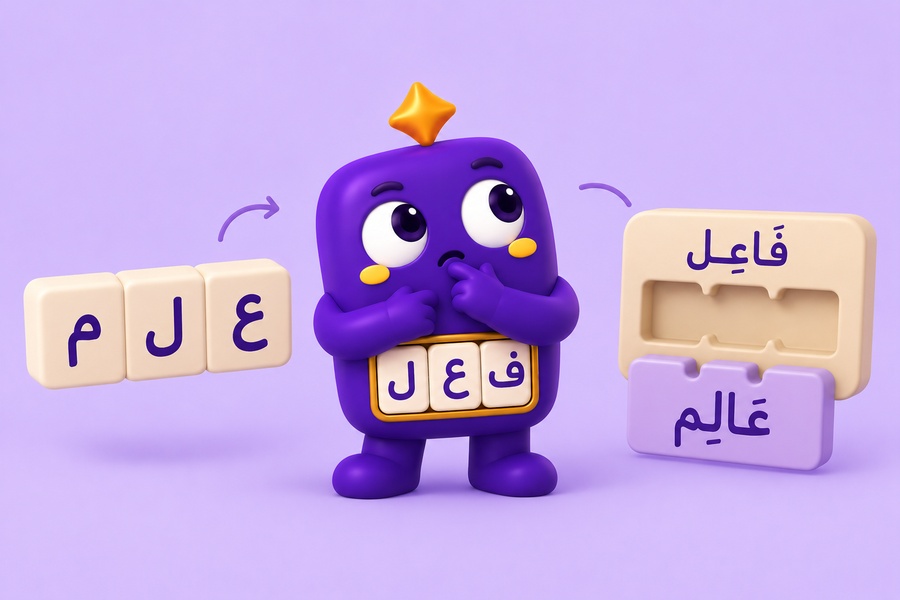
Learning Arabic roots is more effective than memorizing isolated words because it organizes vocabulary into connected families. When you learn the root ع ل م, you can link it to words such as عِلْم (ʿilm, knowledge), مُعَلِّم (muʿallim, teacher), and تَعَلُّم (taʿallum, learning). Instead of memorizing every word from scratch, you build a network that makes vocabulary easier to remember and helps you understand new words. Still, knowing the root does not replace learning each word's meaning in context.
Introduction
A learner may memorize twenty Arabic words in the evening, only to wake up the next morning and remember just a few of them. The problem is not always poor memory or a lack of effort. Sometimes, it lies in the way the words were presented. When every word appears in isolation, the brain must create a separate connection for it and retain its sound, spelling, meaning, and usage independently.
This is why memorizing long lists of Arabic vocabulary is not the best way to build a vocabulary you can actually use. A list may help you pass a short quiz, but it rarely reveals the relationships between words. It does not explain why certain words resemble one another, nor does it give you a clear way to approach a word you are seeing for the first time.
This is where learning Arabic roots becomes valuable. Many Arabic words do not exist in isolation. Instead, they belong to groups that share original letters and revolve around a broad semantic field. Once learners recognize those letters, they begin to see the connections hidden beneath the different forms of the words.
Consider these words:
- عِلْم (ʿilm, knowledge)
- عَالِم (ʿālim, scholar)
- مَعْلُوم (maʿlūm, known)
- مُعَلِّم (muʿallim, teacher)
- تَعَلُّم (taʿallum, learning)
In a traditional vocabulary list, these may look like five separate items. In reality, they all belong to the root ع ل م. When they are organized into an Arabic word family, the relationship between them becomes easier to recognize and retrieve from memory.
This does not mean that knowing the root automatically gives you the full meaning of every derivative, or that vocabulary lists have no value. The root provides a starting point, while the precise meaning depends on the word's form, context, and actual usage. In this article, you will learn how to use roots to organize your vocabulary, how to combine roots with patterns and context, and when you still need to learn a word as it is.
Why Does Memorizing Word Lists Become Exhausting?
Traditional vocabulary lists often bring together words that have no obvious relationship. A learner might be given a list like this:
- طَبِيب (ṭabīb, doctor)
- مَفْتُوح (maftūḥ, open)
- شَجَرَة (shajara, tree)
- سَائِق (sāʾiq, driver)
- مَعْلُومَة (maʿlūma, piece of information)
Each word requires its own connection in memory. If it is not used in a sentence or linked to an image, topic, or word family, it can easily disappear once the review session ends.
Another problem is that a list usually tells you what a word means without revealing how it was built. A student may memorize that مَعْلُومَة means piece of information without noticing its relationship to عِلْم, مَعْلُوم, and عَلِمَ. As a result, the learner misses a connection that could have helped with four words instead of only one.
The problem, then, is not the existence of vocabulary lists. It is using them as the only method of learning. Words memorized without meaningful connections often require more review and remain harder to recall during reading or conversation.
How Does the Root Organize Arabic Vocabulary?
A root is a group of original letters that appears in several words connected by a shared core meaning. Most Arabic roots consist of three letters, although quadriliteral roots also exist.
Take the root:
ع ل م — ʿ-l-m
It is associated with knowledge, learning, and awareness.
These letters appear in many words:
| Arabic word | Pronunciation | English meaning | Relationship to the semantic field |
|---|---|---|---|
| عَلِمَ | ʿalima | he knew | he gained knowledge of something |
| عِلْم | ʿilm | knowledge | knowledge itself |
| عَالِم | ʿālim | scholar | a person who possesses knowledge |
| مَعْلُوم | maʿlūm | known | something that has become known |
| مَعْلُومَة | maʿlūma | piece of information | a specific piece of knowledge |
| عَلَّمَ | ʿallama | he taught | he passed knowledge on to someone |
| تَعَلَّمَ | taʿallama | he learned | he acquired knowledge |
| مُعَلِّم | muʿallim | teacher | someone who teaches others |
| مُتَعَلِّم | mutaʿallim | learner | someone who acquires knowledge |
| تَعْلِيم | taʿlīm | education / teaching | the process of teaching |
Instead of memorizing ten unrelated flashcards, you now have one center from which ten words branch out. This organization is the main advantage of learning Arabic roots: every new word finds a place within a network that already exists.
What Is a Word Family?
A word family is a group of words that share the same morphological origin but differ in form, function, and usage.
The ع ل م family can be represented visually as one root branching into its different derivatives.
Organizing Arabic word families helps you see three things at once:
- The original letters shared by the words
- The broad idea connecting them
- The difference each form creates in meaning and function
Belonging to the same family does not mean the words are synonyms. مُعَلِّم (muʿallim, teacher) is not synonymous with مُتَعَلِّم (mutaʿallim, learner), even though both come from the same root. The first refers to someone who gives knowledge, while the second refers to someone who acquires it.
How Does the Root Help You Remember Words?
When you memorize an isolated word, you may have only one connection:
مُعَلِّم = teacher
When you learn it as part of its family, several connections begin to form:
- مُعَلِّم is connected to the root ع ل م.
- It is related to the verb عَلَّمَ (ʿallama, taught).
- It is connected to the process of تَعْلِيم (taʿlīm, teaching/education).
- It differs from مُتَعَلِّم (mutaʿallim, learner).
- It can be used in a sentence about school or education.
If you momentarily forget the English translation, these connections may help you recover the meaning. You are no longer searching your memory for one isolated card; you are reaching the word through a network of relationships.
A study published in Applied Psycholinguistics indicates that root awareness is an important aspect of morphological awareness in Arabic. In a sample of 194 Arabic-speaking third-grade children, measures of root awareness were associated with word-reading performance, reading fluency, and reading comprehension. The study does not directly compare root-based learning with memorizing word lists, but it offers evidence that recognizing roots plays an important role in processing and reading Arabic words.
Can You Infer the Meaning of a New Word from Its Root?
A root can give you an initial direction toward the meaning, but it cannot guarantee an exact translation.
Imagine that you already know:
سَبَقَ — sabaqa — "he preceded / went ahead"
Then you encounter:
مُسَابَقَة — musābaqa — "competition"
The letters س ب ق help you connect the new word with the idea of going ahead or preceding. The form and context may then lead you to expect that the word refers to a competition in which participants try to get ahead of one another.
The root alone, however, is not always enough. Consider these two words:
عَالَم — ʿālam — "world"
عَالِم — ʿālim — "scholar"
A change in the vowel creates a clear difference in both pronunciation and meaning. Linguistic history and actual usage may also make the semantic relationship between certain derivatives less obvious to modern learners.
Use the root to form a hypothesis, not to make a final judgment. Then confirm the word through context or a reliable dictionary.
How Do Patterns Support Roots?
The root connects a word to its semantic field, while the pattern helps reveal its structure and function. You gain the greatest benefit when the two are studied together.
Compare these words from the root ل ع ب:
| Arabic word | Pronunciation | Pattern | Meaning |
|---|---|---|---|
| لَعِبَ | laʿiba | فَعِلَ | he played |
| لَاعِب | lāʿib | فَاعِل | player |
| مَلْعُوب | malʿūb | مَفْعُول | played |
| مَلْعَب | malʿab | مَفْعَل | playground / stadium |
The root tells us that the words are connected to playing. The patterns reveal the differences:
- لَاعِب is the person who performs the action.
- مَلْعُوب is something upon which the action is performed.
- مَلْعَب is the place where the action occurs.
These relationships make Arabic word families more than groups of words with similar letters. They reveal how meanings and grammatical roles are distributed among the members of a family.
Does Studying Roots Replace Vocabulary Memorization?
No. This point must be made clearly so that a useful method does not turn into a misleading rule.
You still need to learn:
- The precise meaning of the word
- Its correct pronunciation
- The preposition that may accompany it
- Its plural if it is irregular
- The natural contexts in which it is used
- The differences between it and similar words
Take the word:
اِسْتَعْمَلَ — istaʿmala — "he used"
The root ع م ل may help you connect the word with the idea of work or action, but the full meaning "to use" cannot always be derived from the root alone. You need to see the word in a sentence:
اِسْتَعْمَلَ الطَّالِبُ القَامُوسَ. istaʿmala al-ṭālibu al-qāmūsa "The student used the dictionary."
This approach does not replace Arabic vocabulary memorization. It reorganizes it. You are still learning words, but you are no longer leaving them scattered.
When Are Vocabulary Lists Useful?
Vocabulary lists are useful when they are built around a clear purpose, such as:
- Airport vocabulary
- Words learners need in a restaurant
- Common conversational verbs
- Words taken from a single text
- Reviewing vocabulary learned previously
If you are traveling tomorrow, learning جَوَاز سَفَر (jawāz safar, passport) and بَوَّابَة (bawwāba, gate) may be more useful than studying every derivative of their roots. Immediate needs do not always leave time for a complete morphological analysis.
The proper comparison is not between one useful method and one worthless method. The problem begins when learners rely on memorizing Arabic vocabulary in isolated lists without context, word families, or practical review.
The best approach combines both methods: use a short list that serves a real topic, then connect the words that can be analyzed to their roots and derivatives.
What Is the Difference Between the Two Lists?
| An isolated list | A connected family |
|---|---|
| مُعَلِّم — teacher | Root: ع ل م |
| مَفْتُوح — open | عَلِمَ — ʿalima — knew |
| سَائِق — driver | عِلْم — ʿilm — knowledge |
| تَعَلُّم — learning | مُعَلِّم — muʿallim — teacher |
| مَكْسُور — broken | تَعَلُّم — taʿallum — learning |
| No clear relationship appears | Every word is connected to one shared center |
The list on the right still requires review and practical use, but it gives learners a structure for organizing what they are learning.
How Can You Learn Vocabulary Through Roots?
1. Choose a Common Root
Begin with a root that appears in words useful to beginners, such as:
ف ت ح — f-t-ḥ
It is associated with opening and openness.
2. Collect a Limited Number of Words
Do not gather twenty derivatives in your first session. Choose four or five:
| Arabic word | Pronunciation | Meaning |
|---|---|---|
| فَتَحَ | fataḥa | he opened |
| فَتْح | fatḥ | opening |
| فَاتِح | fātiḥ | opener / conqueror |
| مَفْتُوح | maftūḥ | open |
| مِفْتَاح | miftāḥ | key |
3. Notice the Function of Each Form
Do not stop at recognizing the shared letters. Ask:
- Which word is a verb?
- Which word describes something that is open?
- Which word names a tool?
- What additional letters appear in each word?
4. Put Every Word in a Sentence
فَتَحَ سَامِرٌ البَابَ. fataḥa Sāmirun al-bāba "Samer opened the door."
البَابُ مَفْتُوحٌ. al-bābu maftūḥun "The door is open."
أَيْنَ المِفْتَاحُ؟ ayna al-miftāḥu? "Where is the key?"
5. Review the Family as One Unit
During your next review session, write the root first and try to recall its derivatives. Then reverse the process: look at each derivative and try to identify its original letters.
This turns learning Arabic roots into an exercise in understanding and recall instead of another list of symbols to memorize.
A Complete Practical Example: The Root ن ظ م
The root ن ظ م revolves around arrangement, composition, and order.
| Arabic word | Pronunciation | English meaning | Explanation |
|---|---|---|---|
| نَظَمَ | naẓama | he arranged / composed | he arranged things or composed them |
| نِظَام | niẓām | system | an ordered set of rules or elements |
| تَنْظِيم | tanẓīm | organization | the process of arranging and organizing |
| مُنَظِّم | munaẓẓim | organizer | a person or thing that organizes |
| مُنَظَّم | munaẓẓam | organized | something that has been arranged |
| اِنْتَظَمَ | intaẓama | he became orderly / joined regularly | he entered an organized system or became orderly |
| اِنْتِظَام | intiẓām | regularity | the state of continuing according to a fixed order |
Now read these sentences:
نَظَمَ الشَّاعِرُ القَصِيدَةَ. naẓama al-shāʿiru al-qaṣīdata "The poet composed the poem."
هٰذَا نِظَامٌ وَاضِحٌ. hādhā niẓāmun wāḍiḥun "This is a clear system."
نَحْتَاجُ إِلَى تَنْظِيمِ الوَقْتِ. naḥtāju ilā tanẓīmi al-waqti "We need to organize time."
المَلَفُّ مُنَظَّمٌ. al-malaffu munaẓẓamun "The file is organized."
Through this method, you have learned several words, seen each one in context, and connected them all to a shared semantic core. This is the practical value of Arabic word families.
What Mistakes Should You Avoid?
Memorizing the Root Without Its Derivatives
Knowing that ن ظ م is a root offers little benefit if you do not connect it to actual words. The root is a key, not a goal detached from real usage.
Assuming That Every Possible Derivative Is Common
Morphological rules may allow several forms, but that does not mean all of them are equally common. Begin with the words you actually encounter in reading and conversation.
Forcing Every Word into One Meaning
Derivatives of the same root do not share one fixed translation. Meaning emerges from the root, pattern, and context together.
Trying to Guess Every Word
Guessing is a useful skill, but it must be followed by verification. If the expected meaning does not fit the sentence, consult a dictionary.
Studying Enormous Word Families at Once
Learners can easily turn the root-based method into another kind of long vocabulary list. It is better to choose five useful words and add new derivatives gradually.
Did You Know?
A study of root awareness among Arabic-speaking children found that it was associated with word reading, fluency, and reading comprehension. This does not prove that studying roots is better than every other learning method in every situation. It does, however, show that recognizing root structure is more than a grammar exercise; it is connected to the way readers process Arabic words.
The root can therefore be viewed as a tool for organizing the mental lexicon, not merely as an answer required on a morphology test.
Summary
- Roots organize words into connected networks instead of leaving them as isolated vocabulary items.
- A root can help you remember words and form an initial expectation about their meanings.
- The pattern clarifies the function of each derivative within the family.
- A root does not always provide an exact translation; context and dictionaries remain essential.
- The method is not meant to eliminate Arabic vocabulary memorization, but to make it more organized.
- Begin with four or five common words from each root.
- Add pronunciation, translation, and a natural sentence for every derivative.
- Review the root through active recall and comparison, not silent reading alone.
Frequently Asked Questions
Is Learning Arabic Roots Suitable for Beginners?
Yes, provided that beginners start with common roots and clear derivatives. They do not need to master every rule of weak-letter changes and assimilation before benefiting from the connections between words.
How Many Words Should I Learn from Each Root?
Begin with four or five common words. Once they become familiar, add new words that you encounter in a text or conversation.
Can I Determine the Meaning of Any Word from Its Root?
No. The root gives you a broad semantic field, but the word's form, context, and established lexical usage determine its precise meaning.
Should I Learn the Root or the Pattern First?
You can begin with the root because it reveals the relationship between words. Then gradually learn common patterns to understand the function of each form.
Do I Need to Memorize the Original Letters of Every Word?
It is useful to know them in common words that can be analyzed easily, but the goal is not to turn every reading session into a morphology exam. Use the root whenever it helps you understand and remember.
What Should I Do If Two Words Have Similar Letters?
Do not immediately assume that they come from the same root. Check the order of the letters and the semantic relationship, then consult a reliable dictionary if you are unsure.
Are Vocabulary Lists Useless?
No. They are useful for review and practical topics, but they become less effective when they contain isolated words without sentences or meaningful connections. Combine them with context, roots, and spaced review.
What Is the Best Way to Build Arabic Word Families?
Choose a common root and collect a small number of its derivatives. Then write down each word's pattern, pronunciation, meaning, and a natural sentence that uses it.
The One-Minute Rooto Challenge
Go to the Rooto Machine and press SPIN. When a random root appears, do not read all the information immediately. Give yourself one minute and try to recall another word that belongs to the same root.
Then read the derivative displayed by the machine and notice its pattern, Arabic example, and English translation. Write both derivatives on the same flashcard instead of placing each word in a separate list. Repeat the challenge with three roots, and you will have created three small word families through exploration rather than mechanical memorization.
References Used
- ابن إيّاز. شرح التعريف بضروري التصريف. تحقيق وشرح ودراسة هادي نهر وهلال ناجي المحامي، دار الفكر للطباعة والنشر والتوزيع، الأردن، الطبعة الأولى، 1422هـ/2002م.
- Tibi, Sana, Jamie L. Tock, and John R. Kirby. (2019). "The Development of a Measure of Root Awareness to Account for Reading Performance in the Arabic Language: A Development and Validation Study." Applied Psycholinguistics, 40(2), 303–322.